What Is Space Weather?

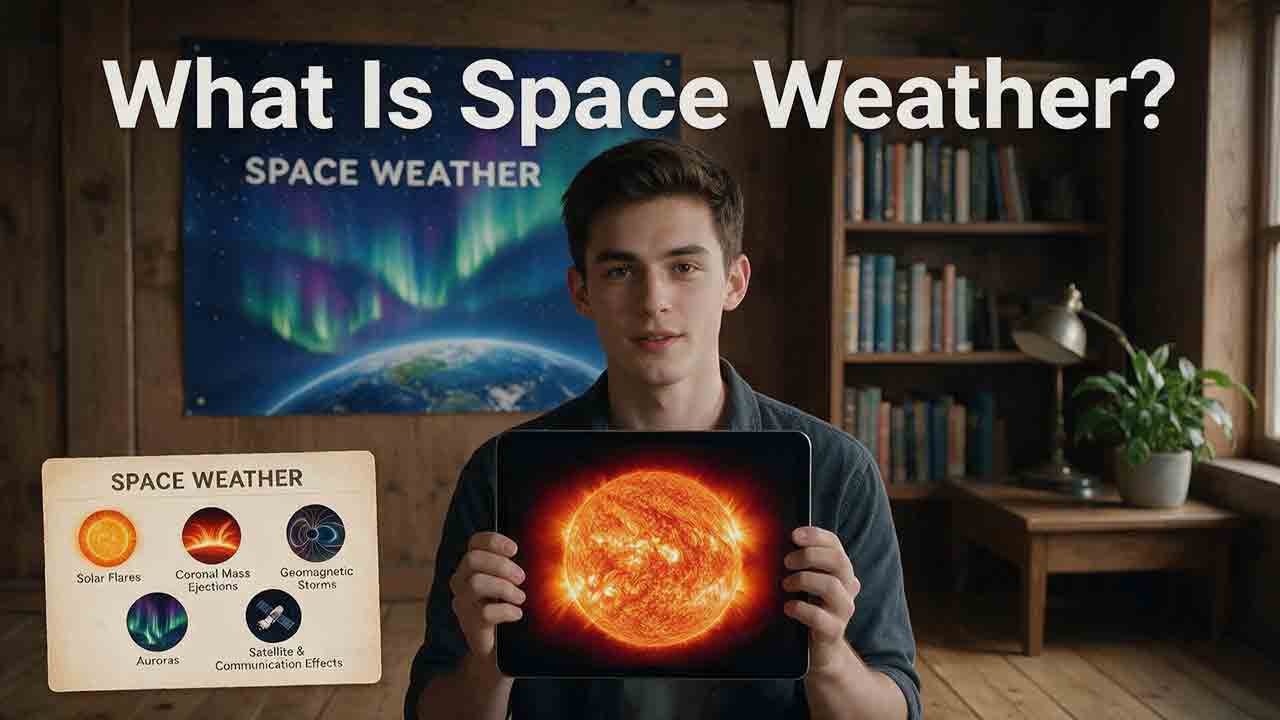
What Is Space Weather?
Space weather is the changing environment created by the Sun’s radiation, charged particles, solar wind, and magnetic eruptions. When those disturbances interact with Earth’s magnetosphere and upper atmosphere, they can produce auroras and affect satellites, navigation, radio communication, power systems, aviation, and astronauts. Most events pose little direct danger to people on the ground.
Key Takeaways
- Space weather begins mainly with solar activity, but a solar eruption does not automatically create a serious effect at Earth.
- Solar flares, coronal mass ejections, solar radiation storms, radio blackouts, and geomagnetic storms are different phenomena, even when they are associated with the same active region.
- NOAA uses three separate severity scales: G for geomagnetic storms, S for solar radiation storms, and R for radio blackouts.
- The practical effect depends on exposure, system sensitivity, location, and timing, not just the largest number shown in a forecast.
- Most people need information rather than emergency action, while satellite, aviation, power-grid, radio, navigation, and human-spaceflight teams may need specialized operational data.
This guide focuses on space weather as it affects Earth and near-Earth technology. It explains how the main phenomena differ, how to read an official forecast, which measurements matter, and what different users should do with the information.
In This Guide
- How space weather develops
- The main types of space weather
- Solar flares compared with CMEs
- Effects on satellites, GPS, radio, aviation, and power systems
- NOAA G, S, and R scales
- How to interpret Kp and Bz
- A practical forecast-reading method
- Lessons from the May 2024 geomagnetic storm
- Common mistakes and troubleshooting
- Frequently asked questions and authoritative sources
How Does Space Weather Develop?
Space weather develops through a chain connecting the Sun, interplanetary space, Earth’s magnetic environment, and an exposed technology or observer.
The Sun continuously releases the solar wind, a stream of electrically charged particles carrying an embedded magnetic field. Most of the time, this flow produces ordinary background conditions around Earth.
Solar flares, coronal mass ejections, high-speed solar-wind streams, and energetic-particle events can temporarily disturb that environment. If an Earth-directed disturbance arrives, it may compress or energize the magnetosphere, change the ionosphere, heat the upper atmosphere, and increase electrical currents in near-Earth space or at the ground.
Possible results include:
- brighter or more widespread auroras;
- degraded radio communication;
- reduced satellite-navigation accuracy;
- increased drag on low-Earth-orbit satellites;
- spacecraft charging or electronic upsets;
- geomagnetically induced currents in long conductors.
A solar eruption does not automatically produce all these effects. The source, carrier, Earth interaction, exposed system, and possible consequence must be considered separately.
The Five-Link Space Weather Chain
The Five-Link Space Weather Chain is an original editorial framework for understanding how a solar event may—or may not—produce a practical effect.
Source Event → Carrier → Earth Interaction → Exposed System → Observable Effect
This is an explanatory framework, not an official NOAA scale, scientific index, or operational forecasting model.
| Link | Question to Ask | Example |
|---|---|---|
| Source event | What happened at the Sun? | A solar flare, CME, or high-speed stream |
| Carrier | What transports the disturbance or energy? | Radiation, energetic particles, plasma, or magnetic fields |
| Earth interaction | Which part of the near-Earth environment responds? | Ionosphere, magnetosphere, radiation belts, or thermosphere |
| Exposed system | What is located in the affected environment? | Satellite, radio path, aircraft, power line, or astronaut |
| Observable effect | What could change? | Signal loss, navigation error, drag, charging, induced current, or aurora |
The framework prevents a common reasoning error: jumping directly from “the Sun erupted” to “major disruption will occur.”
A meaningful effect requires the chain to remain connected. The disturbance must reach or influence Earth, interact efficiently with the near-Earth environment, and encounter a system that is sensitive to that specific condition.
Example: Following an Earth-Directed CME
| Framework Link | Example |
|---|---|
| Source event | An active solar region launches a CME |
| Carrier | A cloud of magnetized plasma travels through the solar wind |
| Earth interaction | A prolonged southward magnetic field transfers energy into the magnetosphere |
| Exposed system | A long, grounded electrical transmission network |
| Possible effect | Geomagnetically induced current enters parts of the network |
This example describes a possible chain, not a guaranteed outcome. CME direction, arrival structure, magnetic orientation, storm duration, regional geology, grid design, and operating conditions all influence the result.
What Are the Main Types of Space Weather?
The main space-weather phenomena differ in what moves through space, how quickly Earth responds, and which systems are most exposed.
| Phenomenon | Direct Definition | Main Carrier or Process | Common Concern | NOAA Scale |
|---|---|---|---|---|
| Solar flare | A rapid release of electromagnetic radiation from the Sun | X-rays and extreme-ultraviolet radiation | HF radio degradation on Earth’s sunlit side | R when thresholds are reached |
| Coronal mass ejection | A large expulsion of plasma and magnetic field from the solar corona | Magnetized plasma | Possible geomagnetic storm after arrival | May produce G-scale activity |
| Solar energetic particle event | A rapid increase in high-energy particles from the Sun | Protons, electrons, and heavier ions | Spacecraft effects and radiation exposure | S when thresholds are reached |
| High-speed solar-wind stream | Fast solar wind commonly flowing from a coronal hole | Plasma and embedded magnetic field | Recurrent geomagnetic activity | May produce G-scale activity |
| Geomagnetic storm | A major disturbance of Earth’s magnetosphere | Energy transferred from the solar wind | Aurora, satellite effects, navigation errors, and induced currents | G |
| Radio blackout | Degradation of certain radio signals after solar X-rays change the ionosphere | Flare radiation acting on the ionosphere | HF communication loss on the sunlit side | R |
| Aurora | Light emitted when energized particles interact with the upper atmosphere | Particle precipitation and atmospheric excitation | Visible evidence of energy entering the upper atmosphere | No separate NOAA storm scale |
The official severity definitions and possible effects are listed in the NOAA Space Weather Scales.
How Are Solar Flares and CMEs Different?
A solar flare is a rapid burst of electromagnetic radiation, while a coronal mass ejection, or CME, is a moving cloud of plasma and magnetic field.
Flare radiation travels at the speed of light. Its effects on the sunlit ionosphere occur essentially when the flare is detected near Earth.
A CME travels much more slowly. According to the NOAA Space Weather Prediction Center, the fastest Earth-directed CMEs may arrive in approximately 15–18 hours, while slower CMEs may take several days.
These values describe observed ranges, not a fixed minimum or a guaranteed transit time. Forecasters must estimate a CME’s three-dimensional direction, speed, width, and evolution from remote observations.
A solar flare and CME can occur together, but neither guarantees the other. A powerful flare can occur without a significant Earth-directed CME, and an Earth-directed CME does not need to accompany the strongest flare category.
Direction also matters. A visually dramatic CME traveling away from Earth may have little effect here, while a less visually impressive Earth-directed eruption may become operationally important.
Solar Flare vs. CME
| Question | Solar Flare | Coronal Mass Ejection |
|---|---|---|
| What leaves the Sun? | Electromagnetic radiation | Plasma and magnetic field |
| How quickly can Earth respond? | On the light-travel timescale | Usually hours to several days |
| Where do the first major effects occur? | Primarily in the sunlit ionosphere | In the magnetosphere and upper atmosphere after arrival |
| What is a common result? | HF radio blackout | Possible geomagnetic storm |
| Does it automatically create visible aurora? | No | No |
| Does flare class determine the G level? | No | No |
| Does CME speed alone determine storm severity? | Not applicable | No |
What Is a Solar Radiation Storm?
A solar radiation storm occurs when energetic proton levels near Earth rise above thresholds defined by NOAA.
The particles may affect spacecraft electronics, imaging instruments, solar arrays, astronauts outside substantial shielding, and HF radio communication through polar regions. At stronger levels, radiation exposure can also become more important for high-altitude, high-latitude aviation.
NOAA rates solar radiation storms from S1, Minor, to S5, Extreme. The scale is based on measurements of protons with energies of at least 10 MeV.
An S1 event begins when the flux of protons at energies of 10 MeV or greater reaches 10 proton flux units, or pfu. One pfu represents one particle per square centimeter per second per steradian above the stated energy threshold.
The complete operational definition is available on NOAA’s Solar Radiation Storm page.
An S level is not a solar-flare class and does not measure geomagnetic disturbance. A strong flare may be associated with an energetic-particle event, but the flare’s X-ray intensity alone does not determine the eventual S level.
Warning time can be limited because the fastest energetic particles travel much faster than a CME. In well-connected events, thresholds may be reached with little useful advance notice.
What Is a Geomagnetic Storm?
A geomagnetic storm is a major disturbance of Earth’s magnetosphere caused by sustained energy transfer from the solar wind.
Strong storms are often associated with CMEs, although high-speed solar-wind streams can also produce geomagnetic activity. An important factor is the direction of the magnetic field carried by the solar wind.
A prolonged southward-directed interplanetary magnetic field can interact efficiently with Earth’s magnetic environment. This allows more energy to enter the magnetosphere. A northward orientation generally reduces that coupling, even when solar-wind speed is high.
During a geomagnetic storm:
- auroral activity may expand toward lower geomagnetic latitudes;
- the ionosphere may become irregular;
- satellite-navigation accuracy may decline;
- the upper atmosphere may heat and expand;
- drag on low-Earth-orbit satellites may increase;
- spacecraft charging and orientation problems may become more likely;
- changing magnetic fields may induce electric fields in the ground;
- those electric fields may drive currents through power networks and pipelines.
NOAA rates geomagnetic storms from G1, Minor, to G5, Extreme.
A G-scale forecast describes broad environmental conditions and possible effects. It does not mean that every effect listed for that category will occur in every location.
How Does Earth Protect People?
Earth’s magnetic field and atmosphere provide substantial protection from solar particles and radiation.
The magnetosphere redirects much of the solar wind around Earth. The atmosphere absorbs most harmful radiation and particles that penetrate farther downward.
For that reason, people at ground level generally do not need to seek shelter during ordinary solar or geomagnetic storms. The most common public consequences are indirect effects on technology, communication, navigation, transportation, or electrical infrastructure.
Protection is not uniform. Astronauts, spacecraft, and high-altitude polar flights operate with less atmospheric shielding. Charged particles can also enter high-latitude regions more readily because of the geometry of Earth’s magnetic field.
NASA explains the role of the magnetosphere and space-weather monitoring in its Space Weather overview.
How Does Space Weather Affect Technology?
Space weather does not affect every technology equally.
The practical result depends on altitude, latitude, signal frequency, shielding, grounding, equipment design, regional geology, redundancy, operating state, and the duration of the disturbance.
Satellite Operations and Orbital Drag
Satellites may experience:
- surface or internal charging;
- single-event electronic upsets;
- sensor noise;
- communication problems;
- orientation anomalies;
- solar-array degradation;
- changes in orbital drag.
A geomagnetic storm can heat and expand the upper atmosphere. At low-Earth-orbit altitudes, the increased atmospheric density creates more drag.
Additional drag can reduce orbital altitude and make orbital predictions less certain. Operators may need to update orbit models, adjust spacecraft orientation, postpone sensitive operations, or investigate unexpected changes.
Two satellites in similar orbits may respond differently because of differences in shielding, electronics, software, design margins, and onboard fault protection.
Why Precision GNSS Is More Vulnerable
Signals from GPS and other Global Navigation Satellite Systems must travel through the ionosphere before reaching a receiver.
Space-weather disturbances can change the ionosphere’s electron density. This may introduce signal delays, rapid fluctuations, reduced accuracy, or temporary loss of signal lock.
A consumer smartphone may continue to display an apparently normal position while precision agriculture, surveying, drilling, aviation, scientific timing, or correction-based systems experience unacceptable errors.
The useful question is not simply:
Is GPS working?
It is:
Does the current error exceed the accuracy, continuity, and integrity requirements of this application?
Radio Effects on the Sunlit Side
Strong solar flares can increase ionization in the lower ionosphere on Earth’s sunlit side.
This additional ionization can absorb high-frequency radio waves, especially within the 3–30 MHz HF band. The result may be weak signals, reduced communication range, or a temporary radio blackout.
A flare-related radio blackout is not automatically global. The most immediate effects occur primarily on the side of Earth facing the Sun when the flare happens.
Energetic solar particles can also degrade HF communication through polar regions. These effects matter to aviation, maritime operations, emergency communication, amateur radio, and other services that rely on long-distance HF propagation.
Why Local Geology Changes Power-Grid Risk
Rapid changes in Earth’s magnetic field can produce electric fields at the surface. These geoelectric fields may drive geomagnetically induced currents through grounded, long-distance transmission systems.
The risk is not determined by the G level alone.
Important factors include:
- grid configuration;
- transformer design;
- transmission-line length and orientation;
- grounding;
- current operating conditions;
- storm duration;
- electrical conductivity beneath the surface.
USGS research shows that geoelectric hazards vary geographically because underground conductivity and surface impedance differ between geological regions. The same geomagnetic disturbance can therefore create different electrical conditions in different places.
More information is available from the USGS Geomagnetism Program and its research on magnetic storms and geoelectric hazards.
Pipelines and Other Long Conductors
Geomagnetically induced currents may enter pipelines and interfere with measurements used to manage corrosion protection.
This does not mean that a brief storm instantly destroys a pipeline. It means that operators may need to distinguish storm-related electrical changes from normal system behavior and follow established monitoring procedures.
Aviation at High Altitudes and Latitudes
Space weather can affect aviation through:
- HF radio degradation;
- satellite-navigation uncertainty;
- energetic-particle exposure;
- changes in satellite-supported services.
High-altitude and polar routes deserve particular attention because aircraft in those environments have less atmospheric shielding and may depend more heavily on HF communication.
Commercial aviation uses redundant systems, alternate communication methods, route planning, operational procedures, and specialized advisories to manage these risks. A practical result may be a route change, communication workaround, delay, or increased monitoring rather than an unsafe flight.
The European Space Agency discusses these issues in When the Sun Disrupts Aviation.
Astronauts and Human Spaceflight
Astronauts outside Earth’s strongest natural shielding are more exposed to energetic solar particles.
Mission planners monitor the radiation environment when scheduling spacewalks, choosing spacecraft operating modes, and planning missions beyond low Earth orbit.
Radiation forecasting becomes more important for lunar and deep-space missions because crews may spend more time beyond the protection provided by Earth’s magnetosphere.
Does Space Weather Affect Ordinary Weather?
Space weather and atmospheric weather are different systems.
Atmospheric weather involves temperature, air pressure, moisture, clouds, precipitation, and winds in the lower atmosphere. Space weather mainly involves plasma, electromagnetic radiation, energetic particles, magnetic fields, and changes in the upper atmosphere and near-Earth space.
The lower and upper atmosphere are part of a connected physical system, and researchers study interactions between them. However, a solar flare does not directly create a local hurricane, rainstorm, heat wave, or cold front.
Claims that an individual solar event directly caused a specific ordinary weather disaster require strong evidence and should not be assumed from timing alone.
What Do the NOAA G, S, and R Scales Mean?
NOAA uses three separate five-level scales because geomagnetic storms, solar radiation storms, and radio blackouts are different hazards.
| Scale | Measures | Range | Most Relevant Systems |
|---|---|---|---|
| G | Geomagnetic storms | G1–G5 | Power systems, satellites, GNSS, HF radio, pipelines, and aurora |
| S | Solar radiation storms | S1–S5 | Spacecraft, astronauts, polar aviation, and polar HF radio |
| R | Radio blackouts caused by solar X-rays | R1–R5 | HF communication and some navigation systems on the sunlit side |
The complete categories are published in the NOAA Space Weather Scales.
The scales are not interchangeable. A forecast may contain an R-level event without an S-level radiation storm or a G-level geomagnetic storm.
For example, a forecast might report:
- an R2 radio blackout occurring now;
- no S-scale solar radiation storm;
- a G1 geomagnetic storm expected the following day.
The R2 event concerns immediate ionospheric effects from solar X-rays. The absence of an S event means the specified energetic-proton threshold has not been reached. The later G1 forecast concerns an expected disturbance of Earth’s magnetosphere.
Calling all three conditions a “level-two solar storm” would remove essential information.
What Is the Kp Index?
The Kp index summarizes global geomagnetic disturbance over three-hour intervals.
Kp is useful for describing broad planetary activity, but it is not a direct measurement of conditions at every location. It does not include cloud cover, daylight, local light pollution, flare strength, radiation dose, or the exact navigation error at a specific receiver.
How Kp Corresponds to the NOAA G Scale
| Kp Band | NOAA Geomagnetic Level |
|---|---|
| Below Kp 5 | Below G-scale storm level |
| Kp 5 | G1, Minor |
| Kp 6 | G2, Moderate |
| Kp 7 | G3, Strong |
| Kp 8, including Kp 9− | G4, Severe |
| Kp 9o, often displayed simply as Kp 9 | G5, Extreme |
NOAA places Kp 8 and Kp 9− in G4. G5 corresponds only to Kp 9o, the full Kp 9 level in traditional thirds notation.
The official boundary is shown in NOAA’s Geomagnetic Storm Scale.
For aurora viewing, Kp is one input rather than a guarantee. The auroral oval, geomagnetic latitude, local time, darkness, clouds, moonlight, horizon visibility, and short-term substorm activity also matter.
What Does Bz Mean?
Bz is the north–south component of the interplanetary magnetic field near Earth.
A sustained southward Bz is often favorable for stronger geomagnetic coupling because it allows energy from the solar wind to enter Earth’s magnetosphere more efficiently. A northward Bz generally reduces that coupling.
Bz should not be interpreted alone. Its importance depends on:
- how negative or positive it is;
- how long the orientation persists;
- total magnetic-field strength;
- solar-wind speed;
- solar-wind density;
- the structure of an arriving CME;
- conditions already present in the magnetosphere.
A brief negative Bz reading does not guarantee immediate auroral activity. The response may be delayed, short-lived, geographically uneven, or weaker than expected.
A Practical Forecast-Reading Sequence
A useful reading begins with the hazard type, not the most dramatic number.
Step 1: Identify the Scale
Look for G, S, or R.
- G describes geomagnetic activity.
- S describes energetic-proton radiation conditions.
- R describes flare-related radio blackouts.
Do not compare G2 directly with R2. The numbers belong to different scales.
Step 2: Identify the Product Type
For NOAA geomagnetic products:
- A watch means storm conditions are forecast with longer lead time and greater uncertainty.
- A warning uses upstream solar-wind observations and provides greater confidence in near-term timing or intensity.
- An alert means an observed threshold has been reached.
NOAA states that a geomagnetic-storm watch may cover the current day through the third forecast day, providing up to approximately 72 hours of lead time. Warnings are generally issued minutes to a few hours before expected conditions. Alerts describe conditions being observed now.
The operational definitions are available in NOAA’s Subscription Services and Product Guide.
Step 3: Confirm the Time Standard
Operational space-weather products commonly use Universal Time, written as UT or UTC.
Convert the forecast period to local time before making plans. Check whether the conversion moves the event into the previous or following calendar day.
A period of 03:00–06:00 UTC may correspond to the previous evening in parts of North America but daylight elsewhere.
Step 4: Identify the Affected Geography
Ask where the stated effect is expected.
- Flare-related radio blackouts primarily affect Earth’s sunlit side.
- Energetic-particle events are especially relevant to polar communication and radiation exposure.
- Aurora visibility depends strongly on geomagnetic latitude and darkness.
- Geoelectric risk varies with geology and power-system configuration.
- Satellite exposure depends on orbit, altitude, shielding, and design.
Step 5: Match the Forecast to the System
A G3 forecast may be important to a power-grid operator or satellite controller while requiring no special action from a person using a home computer.
An R2 blackout may matter immediately to an HF radio operator while being almost invisible to someone using fiber-optic internet and a mobile phone.
Step 6: Separate Forecasts From Observations
A forecast describes what may happen. An alert or real-time measurement describes what has already been observed.
Check:
- issue time;
- valid period;
- update time;
- whether the product is a forecast, watch, warning, or alert;
- whether a newer product has replaced it.
Step 7: Continue Checking Updates
A CME’s arrival time and internal magnetic orientation cannot always be determined precisely from solar imagery.
NOAA explains that the Deep Space Climate Observatory near the Sun–Earth L1 region can often provide approximately 15–60 minutes of advance warning after an arriving CME-associated shock is measured upstream. The available time varies with the speed of the solar wind.
See NOAA’s Coronal Mass Ejections page for the official explanation.
A multi-day forecast is a planning tool, not a minute-by-minute guarantee.
Which Information Matters to Different Users?
| User | Check First | Check Next | Practical Purpose |
|---|---|---|---|
| Aurora observer | G forecast, Kp, and auroral oval | Bz, darkness, cloud cover, and local horizon | Decide when and where to observe |
| HF radio operator | R scale and absorption products | S scale and geomagnetic conditions | Anticipate propagation degradation |
| Precision-GNSS user | Ionospheric and geomagnetic conditions | Receiver integrity and correction-service status | Evaluate accuracy and continuity |
| Satellite operator | Particle environment and solar-wind data | Orbit-specific models and spacecraft telemetry | Protect operations and diagnose anomalies |
| Airline dispatcher | Polar communication and radiation advisories | Route, altitude, and backup communication options | Support operational planning |
| Power-grid operator | G forecast and regional geoelectric information | Network configuration and transformer monitoring | Assess induced-current risk |
| General reader | Official alerts and service notices | Aurora information when relevant | Avoid unnecessary alarm |
| Astronaut or mission planner | Energetic-particle and radiation products | Shielding, mission phase, and activity schedule | Manage crew exposure |
How Should Space Weather Risk Be Judged?
A useful practical framework is:
Risk relevance = exposure × sensitivity × consequence
This is an editorial decision framework, not a formal NOAA equation or engineering risk model.
Exposure
Is the system located where the disturbance can affect it?
A polar flight, low-Earth-orbit satellite, sunlit HF path, and grounded transmission line have different exposures.
Sensitivity
Can the system tolerate the disturbance?
Two receivers or satellites may respond differently because of their hardware, software, shielding, antennas, correction services, redundancy, and operating modes.
Consequence
What happens if performance is degraded?
A small navigation error may be insignificant for recreational driving but unacceptable for surveying, automated agriculture, drilling, scientific timing, or aviation.
This framework explains why one event can be an aurora opportunity for a photographer, an operational concern for a satellite team, and nearly unnoticeable to someone else.
Lessons From the May 2024 Geomagnetic Storm
The May 2024 event provides a useful example because several connected solar and geospace processes occurred within a short period.
NASA reported that from May 7 through May 11, 2024, multiple strong solar flares and at least seven CMEs traveled toward Earth. The CMEs arrived in closely spaced waves beginning on May 10 and produced a long-lasting geomagnetic storm that reached G5.
It was the first observed G5 storm since 2003. Auroras were reported at unusually low latitudes, including parts of the southern United States and northern India.
The event is documented in NASA’s How NASA Tracked the Most Intense Solar Storm in Decades.
USGS measurements also classified the May 10 disturbance as G5. Its analysis indicated that grid exposure under the measured conditions was more likely to be concentrated in parts of the eastern United States and upper Midwest because geoelectric risk varies with regional geology.
See the USGS May 10, 2024 Magnetic Disturbance summary.
What the Event Demonstrated
The event did not produce one single “space weather effect.” It involved a sequence:
- Solar flares released electromagnetic radiation.
- Multiple CMEs carried plasma and magnetic fields toward Earth.
- The arriving structures transferred energy into the magnetosphere.
- The ionosphere and upper atmosphere changed.
- Auroral activity expanded.
- Different technologies experienced different types and degrees of disturbance.
The event demonstrated why “solar storm” is often too broad for technical interpretation. Accurate reporting requires identifying the phenomenon, timing, affected region, and exposed system.
NASA’s later review found extensive scientific and technological effects without describing the event as a global technological catastrophe. That distinction matters when evaluating alarming headlines.
What Are the Most Common Misunderstandings?
Mistake 1: Treating Every Solar Flare as Earth-Directed
A solar flare is an emission of radiation, not a plasma cloud traveling toward Earth like a projectile.
A related CME may travel toward Earth, move in another direction, or not occur.
Mistake 2: Using Flare Class as an Aurora Forecast
An X-class flare may attract attention, but flare class alone does not determine whether a strong geomagnetic storm or widespread aurora will follow.
The presence and direction of a CME, its arrival structure, and the magnetic conditions near Earth are more relevant to the later geomagnetic response.
Mistake 3: Calling Every Event a Geomagnetic Storm
A radio blackout or solar radiation storm can occur without a major geomagnetic storm.
Use the G, S, and R categories separately.
Mistake 4: Assuming Effects Are Equal Everywhere
Local outcomes vary with latitude, geology, ionospheric structure, time, signal path, orbit, equipment design, and operating conditions.
A global index cannot describe every local effect.
Mistake 5: Treating Arrival Times as Exact
CME forecasts contain uncertainty because forecasters must estimate a three-dimensional event from remote observations.
Use the forecast window and continue checking official updates.
What Should You Do During an Alert?
Most readers do not need emergency action. The appropriate response depends on the activity or system involved.
For the General Public
- Check NOAA or another official national space-weather service.
- Identify whether the alert uses the G, S, or R scale.
- Avoid treating dramatic social-media posts as operational guidance.
- Follow instructions from utilities, transportation providers, communication services, or public authorities if specific guidance is issued.
- Remember that many alerts produce no noticeable effect on daily life.
For Aurora Observers
- Confirm that the forecast concerns geomagnetic activity rather than only a solar flare.
- Convert UTC times to local time.
- Check the auroral oval, clouds, darkness, moonlight, and horizon.
- Use a safe viewing location away from traffic and restricted property.
- Continue monitoring updates because auroral intensity can change quickly.
For Precision-GNSS Users
- Check receiver and correction-service status.
- Monitor integrity and quality indicators rather than relying only on whether a position appears.
- Compare critical measurements with known reference points when appropriate.
- Postpone nonessential precision work if corrections are unstable or integrity is poor.
For Radio Operators
- Determine whether the communication path is on the sunlit side.
- Check radio-blackout and absorption products rather than using Kp alone.
- Prepare alternative frequencies, paths, or communication methods where appropriate.
- Record the timing and frequency of unusual behavior for later comparison.
For Professional Operators
Satellite, aviation, grid, pipeline, and mission-control teams should use organization-specific engineering procedures, official operational products, internal thresholds, and trained personnel.
A general educational article cannot determine whether a particular asset should be shut down, rerouted, reconfigured, or placed into a protective mode.
Space Weather Forecast Checklist
Use this checklist before acting on a forecast:
- Is the event classified as G, S, or R?
- Is the product a forecast, watch, warning, alert, or observation?
- When was it issued?
- What is its valid UTC period?
- Have I converted the period correctly to local time?
- Is the relevant location on the sunlit side, nightside, or in a polar region?
- Which system could be affected?
- Is that system sensitive to the stated hazard?
- Does the product describe probability, expected severity, or observed conditions?
- Has a newer product replaced it?
- Am I reading the original official source?
- Do local weather or operating conditions change the practical result?
Troubleshooting a Confusing Forecast
“A Strong Flare Occurred, but Kp Is Low”
This is not a contradiction.
The flare’s radiation may have produced an immediate radio blackout, while a related CME has not arrived, missed Earth, or produced weak geomagnetic coupling.
“A CME Arrived, but the Geomagnetic Storm Was Weak”
The CME’s magnetic field may not have remained strongly southward, or Earth may have encountered a less geoeffective part of the structure.
CME speed alone does not determine the G level.
“Kp Is High, but I Cannot See Aurora”
Possible explanations include daylight, clouds, light pollution, moonlight, an obstructed horizon, unfavorable local geometry, or activity occurring outside the observing window.
“GPS Still Works, so the Forecast Must Be Wrong”
Space-weather effects may be intermittent, localized, or application-specific.
A receiver may continue displaying a position while precision, correction availability, timing stability, or integrity is degraded.
“Different Websites Show Different Numbers”
Check whether the sites are showing:
- observed or forecast conditions;
- local K or planetary Kp;
- one-hour or three-hour values;
- model output or official alerts;
- rounded values or Kp thirds;
- different update times.
The products may describe different measurements rather than disagreeing about the same condition.
Why Is Space Weather Difficult to Forecast?
Space-weather forecasting requires observations of the Sun, solar wind, energetic particles, Earth’s magnetic environment, and the upper atmosphere.
Forecasters can observe a CME leaving the Sun and estimate its speed and direction. Its internal magnetic structure, however, may remain uncertain until upstream spacecraft measure it near Earth.
That magnetic structure can help determine whether a fast CME produces limited activity or a major geomagnetic storm.
Forecasting is also difficult because:
- solar eruptions can interact with earlier eruptions;
- CME speed and direction estimates contain uncertainty;
- solar-wind conditions change during transit;
- magnetospheric and ionospheric responses are nonlinear;
- local effects differ from global indices;
- energetic particles may arrive with little warning;
- different technologies respond differently to the same environment.
A useful forecast therefore combines probability, expected severity, arrival windows, real-time observations, and system-specific interpretation.
Does Space Weather Follow a Cycle?
Solar activity follows a cycle of approximately 11 years.
Sunspots, solar flares, and CMEs generally become more frequent around solar maximum and less frequent around solar minimum. Strong events can still occur outside the exact peak, and one solar cycle can differ substantially from another.
A high sunspot count does not mean that a particular eruption will affect Earth. Earth impact still depends on direction, speed, magnetic orientation, and the response of the near-Earth environment.
NASA explains the magnetic basis of this pattern in its Solar Science overview.
Modern society may notice space weather more than earlier generations because it relies heavily on satellites, precise timing, navigation, radio communication, electrical infrastructure, and space-based services.
Greater technological exposure does not necessarily mean that the Sun itself has permanently become more dangerous.
What This Article Does Not Claim
This article:
- is not a real-time space-weather forecast;
- does not replace NOAA alerts or national forecasting services;
- does not provide operating instructions for satellites, power grids, aircraft, pipelines, or crewed spacecraft;
- does not predict that a particular CME will produce a guaranteed result;
- does not treat Kp as a guarantee of aurora at a specific location;
- does not claim that a solar flare directly causes a particular hurricane, heat wave, earthquake, or other terrestrial disaster;
- does not use original satellite, magnetometer, radiation, or ionospheric measurements.
The Five-Link Space Weather Chain and risk-relevance framework are explanatory tools developed for this guide. They are not official scientific indices, engineering standards, or substitutes for a formal risk assessment.
What Should You Remember?
Space weather is the changing radiation, particle, plasma, and magnetic environment produced mainly by solar activity.
Its practical effect depends on more than what happens at the Sun. The disturbance must reach or influence Earth, interact with the surrounding environment, and encounter a system that is sensitive to that condition.
For most people, space weather is something to understand rather than fear. Serious operational decisions belong to trained organizations using real-time measurements, engineering models, system-specific limits, and established procedures.
Recommended Next Steps
- For general learning: Start with the NOAA G, S, and R scales and learn why they describe separate hazards.
- For aurora viewing: Combine geomagnetic information with the auroral oval, darkness, local weather, and safe viewing conditions.
- For radio communication: Monitor radio-blackout and absorption products rather than relying only on Kp.
- For precision navigation: Follow receiver integrity, correction-service status, and professional operating procedures.
- For technical operations: Use official alerts, real-time data, engineering models, and organization-specific guidance.
Frequently Asked Questions
Is space weather dangerous to people on Earth?
Space weather usually poses little direct physical danger to people at ground level because Earth’s atmosphere and magnetic field provide substantial protection.
The more common risks are indirect effects on satellites, radio, navigation, aviation, electrical infrastructure, and spaceflight. Astronauts and some high-altitude polar aviation operations have greater radiation exposure than people on the ground.
Is a solar storm the same as a geomagnetic storm?
No.
“Solar storm” is an informal umbrella term that may refer to flares, CMEs, energetic particles, or several connected events. A geomagnetic storm is specifically a major disturbance of Earth’s magnetosphere caused by energy transferred from the solar wind.
Can a solar flare cause a power outage?
A solar flare’s immediate electromagnetic radiation primarily affects the ionosphere and radio propagation.
Power-grid concerns are more closely associated with geomagnetic disturbances that generate geoelectric fields and geomagnetically induced currents. A flare may accompany a CME that later contributes to those conditions, but flare class alone does not predict a power outage.
Can space weather disrupt the internet?
Space weather does not normally switch off the entire internet.
It may affect satellites, radio links, navigation timing, electrical power, and systems that support parts of modern communication infrastructure. The outcome depends on network design, redundancy, geography, storm severity, and the condition of affected systems.
Does a higher Kp always mean a better aurora?
A higher Kp generally indicates greater global geomagnetic disturbance and may allow auroral activity to expand toward lower geomagnetic latitudes.
It does not guarantee visible aurora at a particular place and time. Darkness, cloud cover, light pollution, the auroral oval, local activity, and viewing geometry remain important.
Where can I find an official space weather forecast?
In the United States, the NOAA Space Weather Prediction Center provides forecasts, watches, warnings, alerts, scales, and real-time observations.
Other authoritative services include the ESA Space Weather Service Network and national meteorological or space-weather agencies.
How This Article Was Reviewed
This article was checked against publicly available information from NASA, NOAA, USGS, and ESA.
The review process included:
- using NOAA definitions for the G, S, and R scales;
- checking NOAA’s Kp-to-G-scale boundary, including Kp 9− and full Kp 9;
- confirming NOAA’s pfu definition and S1 threshold;
- reviewing NOAA descriptions of CME transit times and L1 warning time;
- checking the May 2024 case against NASA and USGS event summaries;
- reviewing USGS information on geology and geoelectric hazards;
- reviewing NASA and ESA explanations of effects on satellites, navigation, aviation, and astronauts;
- separating official scientific definitions from the original explanatory frameworks created for this guide.
This guide is based on published agency documentation and practical interpretation criteria rather than original instrument measurements, private operational data, or hands-on testing.
Official product names, thresholds, links, and interfaces may change. They should be checked again during each scheduled editorial review.
Sources
- NOAA Space Weather Prediction Center: NOAA Space Weather Scales
- NOAA Space Weather Prediction Center: Coronal Mass Ejections
- NOAA Space Weather Prediction Center: Solar Flares and Radio Blackouts
- NOAA Space Weather Prediction Center: Geomagnetic Storms
- NOAA Space Weather Prediction Center: Solar Radiation Storm
- NOAA Space Weather Prediction Center: Subscription Services and Operational Products
- NASA Science: Space Weather
- NASA Science: Solar Science
- NASA Science: How NASA Tracked the Most Intense Solar Storm in Decades
- NASA Science: What NASA Is Learning From the Biggest Geomagnetic Storm in 20 Years
- USGS Geomagnetism Program
- USGS: Magnetic Storms and Geoelectric Hazards
- USGS: May 10, 2024 Magnetic Disturbance
- ESA Space Weather
- ESA Space Weather Service Network
- ESA: When the Sun Disrupts Aviation
Editorial Notes
This article was prepared using the research and source-review process described above. No independent technical review or professional operational approval is claimed.
More from Solar Storms & Space Weather
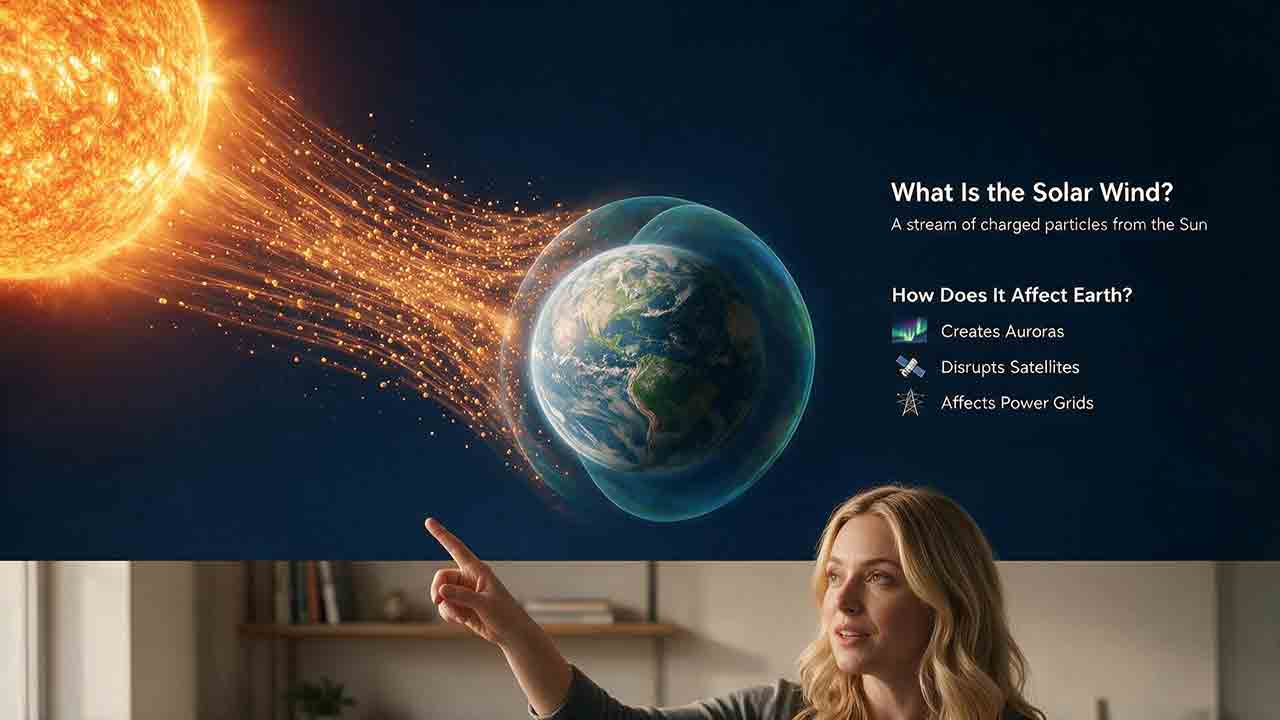
What Is the Solar Wind and How Does It Affect Earth?
The solar wind is a continuous stream of plasma and embedded magnetic fields flowing outward from the Sun. This article explains how that flow interacts with Earth’s magnetosphere and why solar-wind speed alone cannot predict the strength of a geomagnetic disturbance. Readers learn how proton density, dynamic pressure, magnetic-field strength, and southward Bz influence energy transfer into near-Earth space. The guide also distinguishes the solar wind from solar flares, coronal mass ejections, and solar energetic particles. Transparent travel-time and pressure calculations show how common measurements can be interpreted, while a practical decision framework explains how to read real-time NOAA data. The article also examines auroras, satellite drag, GPS accuracy, radio communication, power-grid effects, and the protection provided by Earth’s atmosphere and magnetic field. It emphasizes forecasting limits, data-quality checks, local viewing conditions, and the importance of relying on official space-weather alerts.
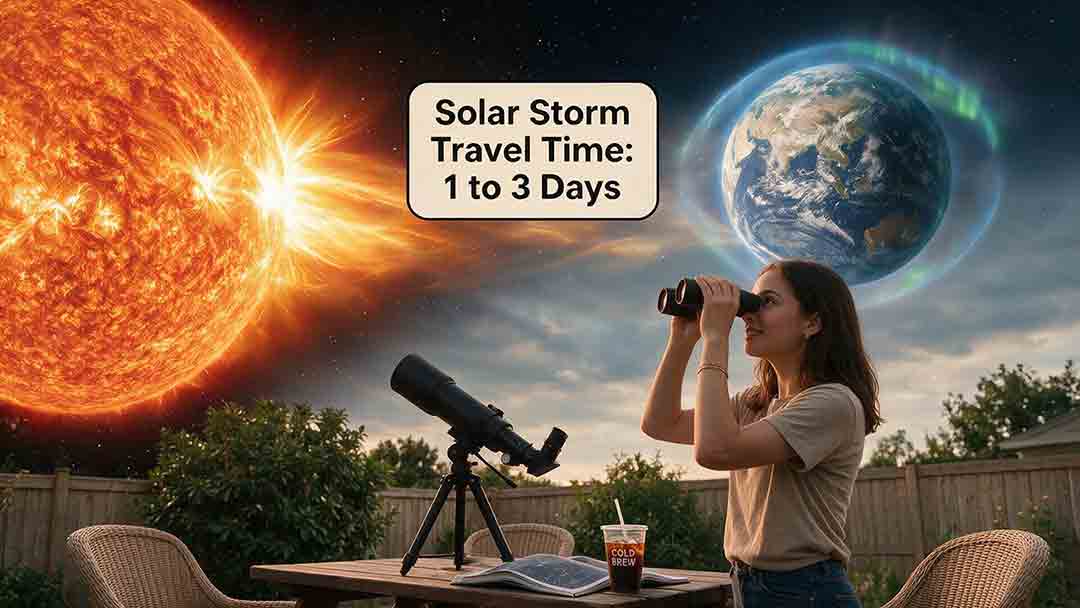
How Long Does a Solar Storm Take to Reach Earth?
A solar storm does not reach Earth on a single timetable because its radiation, energetic particles, and plasma travel at very different speeds. Solar-flare radiation arrives in about 8 minutes 20 seconds, while the fastest solar energetic particles can arrive in tens of minutes or less. An Earth-directed coronal mass ejection, or CME, generally takes one to several days, although exceptional events may arrive in roughly 15–18 hours. This guide introduces the Three-Clock, Two-Window Method for separating these timelines and understanding the difference between an early model forecast and short-term confirmation from spacecraft near the Sun–Earth L1 region. It also provides a transparent constant-speed calculation, real-world CME examples, common timing mistakes, and a practical process for interpreting official space-weather reports. Readers will learn why CME speed alone cannot determine arrival time, geomagnetic-storm strength, or whether aurora will be visible from a specific location.
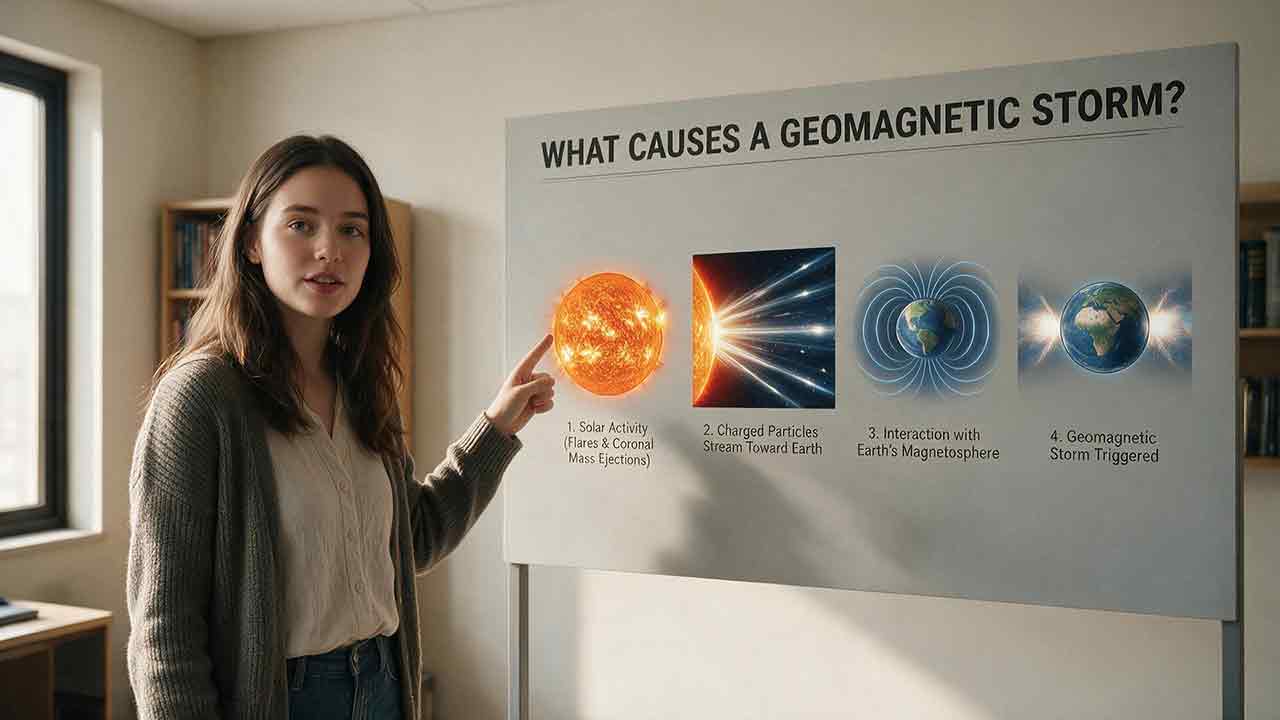
What Causes a Geomagnetic Storm?
A geomagnetic storm develops when a magnetized disturbance in the solar wind reaches Earth and transfers substantial energy into the magnetosphere. This guide explains the two main source pathways: Earth-directed coronal mass ejections, including their shocks and sheath regions, and high-speed solar-wind streams produced by coronal holes and co-rotating interaction regions. It shows why sustained southward Bz is often more important than solar-wind speed or flare class alone, and how magnetic reconnection intensifies currents and particle activity around Earth. The article also introduces a practical Four-Question Storm Potential Test, a transparent coupling calculation, a storm-potential matrix, and a forecast-reading checklist. Readers will learn how Kp, Dst, and local magnetic changes describe different parts of a storm, why forecasts remain uncertain, and how geomagnetic activity may affect auroras, satellites, navigation, radio communication, atmospheric drag, and grounded long-conductor systems.
Explore More Topics
How to Photograph the Northern Lights
Photographing the Northern Lights requires more than choosing one fixed camera setting. This practical guide explains how to select a camera and lens, focus accurately on stars, stabilize your equipment, and adjust shutter speed, aperture, and ISO according to the aurora’s brightness and movement. It includes starting settings for fast, moderate, and faint displays, along with a Motion–Brightness–Foreground framework that helps photographers make better decisions as conditions change. Readers will also learn how to use a smartphone Night mode, compose a stronger foreground, protect color-channel highlights, edit images responsibly, and disclose exposure blends clearly. A quick-reference card, three-frame comparison method, packing checklist, safety guidance, and detailed troubleshooting table make the article useful in the field. The guide relies on published guidance from NASA, NOAA, Nikon, Canon, and Apple while clearly distinguishing authoritative information from adjustable photography recommendations.
How Far South Can the Northern Lights Be Seen?
The northern lights usually remain within high-latitude regions, but powerful geomagnetic storms can carry visible aurora surprisingly far south. This guide explains why there is no single worldwide southern boundary and shows how geomagnetic latitude, the auroral oval, Kp, storm intensity, emission altitude, darkness, cloud cover, and local light pollution affect what an observer may see. It examines NOAA’s generalized U.S. visibility examples for G1 through G5 storms, while clarifying that locations such as Alabama, Florida, and southern Texas represent rare historical possibilities rather than guaranteed forecast limits. Readers will also find an original four-gate decision framework, an auditable geometric viewing-distance example, regional viewing guidance, a practical checklist, and troubleshooting advice for distinguishing faint aurora from clouds or artificial sky glow. The article helps observers decide when a forecast justifies going outside or traveling to a safer, darker viewing site.
What Are the Best Conditions for Seeing the Northern Lights?
The best Northern Lights viewing conditions occur when geomagnetic activity, clear weather, darkness, and a suitable observing location align. This guide explains why the position of the auroral oval matters more than relying on a single Kp value and shows how cloud cover, twilight, light pollution, moonlight, atmospheric transparency, and horizon visibility affect what an observer can see. It introduces the Five-Gate Aurora Viewing Framework, a practical planning tool that evaluates aurora activity, clouds, darkness, location, and available viewing time without presenting the result as a guaranteed probability. Readers will also learn how to compare short- and long-range forecasts, convert UTC forecast periods, choose a safe dark-sky site, recognize faint aurora, and troubleshoot a promising forecast that produces no visible display. The article is based on guidance from NOAA, NASA, the University of Alaska Fairbanks, and the National Park Service.