What Causes a Geomagnetic Storm?

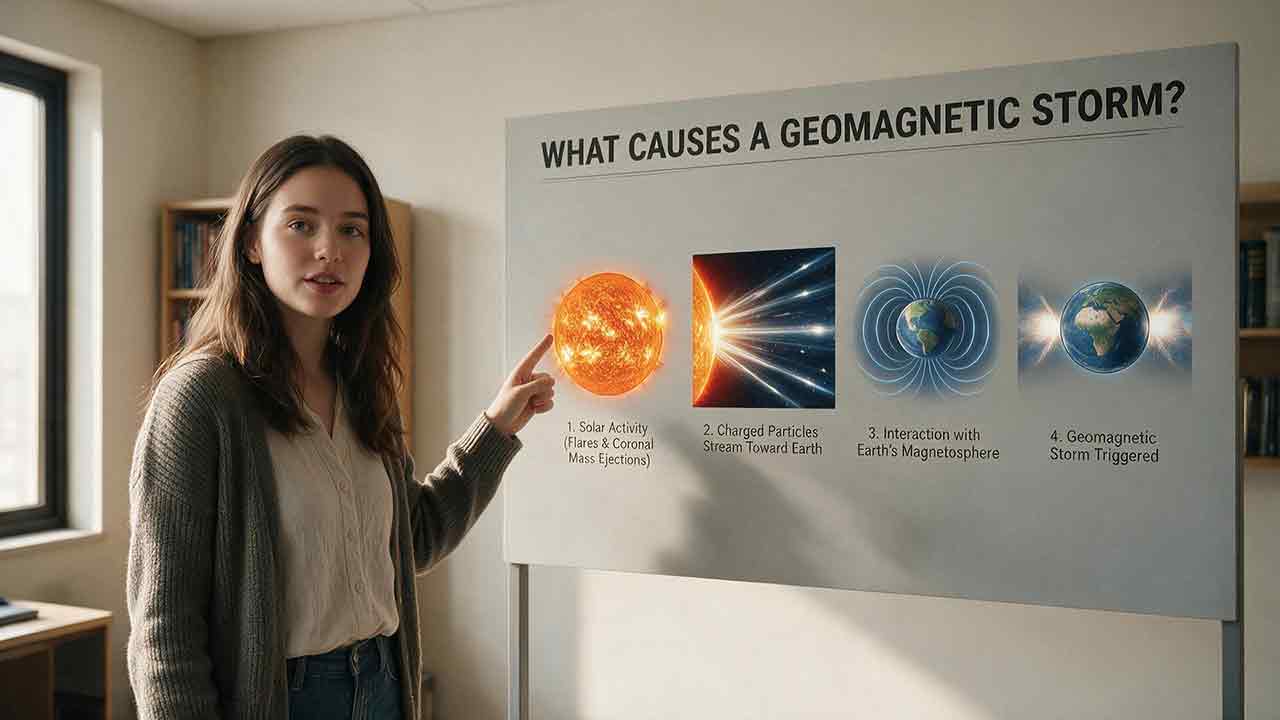
What Causes a Geomagnetic Storm?
A geomagnetic storm occurs when a magnetized disturbance in the solar wind reaches Earth and transfers unusually large amounts of energy into the magnetosphere. The main drivers are Earth-directed coronal mass ejections and high-speed solar-wind streams. The strongest response usually develops when the arriving magnetic field remains southward long enough for efficient magnetic reconnection with Earth’s magnetic field.
Key Takeaways
- Geomagnetic storms are disturbances of Earth’s magnetic environment, not explosions in the atmosphere.
- Coronal mass ejections, or CMEs, cause many of the strongest storms, but only when their path and magnetic structure are geoeffective at Earth.
- Coronal holes can produce recurring high-speed solar-wind streams and co-rotating interaction regions, or CIRs.
- Solar-wind speed matters, but sustained southward Bz is often more important than speed alone.
- Flare class, CME speed, Kp, and the NOAA G scale each describe only part of an event; none provides an exact local-impact forecast.
This article follows both major solar-source pathways, explains the common response after a disturbance reaches Earth, and provides a practical framework for interpreting CME forecasts, solar-wind measurements, Bz, Kp, and reported storm effects.
The explanations are educational. Satellite operators, power-grid organizations, aviation services, and other technical users should rely on official alerts and their own operational procedures.
What Conditions Must Come Together to Cause a Geomagnetic Storm?
A visible solar eruption is not enough by itself. Four broad conditions must align:
- The Sun must produce a suitable magnetized solar-wind disturbance.
- The disturbance must reach Earth rather than missing it.
- Its magnetic field must couple efficiently with Earth’s field.
- The coupling must be strong or sustained enough to intensify currents and plasma activity in near-Earth space.
The NOAA Space Weather Prediction Center describes a geomagnetic storm as a major disturbance of Earth’s magnetosphere caused by an efficient exchange of energy from the solar wind into the space environment surrounding Earth.
That energy usually arrives through one of two routes:
- An eruptive CME route
- A persistent high-speed solar-wind route associated with a coronal hole
The routes begin differently at the Sun, but they converge once the disturbance reaches Earth.
Which Two Solar-Wind Routes Can Start a Geomagnetic Storm?
Route 1: A CME, shock, or sheath travels toward Earth
A coronal mass ejection is a large expulsion of plasma and magnetic field from the Sun’s corona.
CMEs often occur during broader eruptive events that can also include:
- A solar flare
- A filament or prominence eruption
- A coronal dimming
- A shock wave
- Accelerated energetic particles
These phenomena may occur together, but they are not interchangeable.
A solar flare is primarily a burst of electromagnetic radiation. A CME is a moving, expanding magnetic structure. The CME, its shock, or the compressed sheath ahead of it can directly drive a geomagnetic storm if the disturbance reaches Earth with suitable magnetic conditions.
NASA’s Solar Storms and Flares overview explains the different travel times and effects associated with flare radiation, energetic particles, and CMEs.
How does the CME change before it arrives?
A CME does not travel through empty space unchanged. It interacts with the background solar wind and may:
- Accelerate or decelerate
- Expand
- Deflect away from its original path
- Rotate
- Become compressed
- Interact with an earlier CME
- Merge with another solar-wind structure
A fast CME may drive a shock through the slower solar wind ahead of it. Between the shock and the CME’s main magnetic structure is a turbulent, compressed region called the sheath.
Southward magnetic fields may occur:
- In the sheath
- Inside the CME
- In both regions
- In several separate intervals
This is why the strongest storm conditions do not always begin at the first impact.
Route 2: A coronal hole releases a high-speed solar-wind stream
A coronal hole is a relatively cool, low-density region of the solar corona containing open magnetic field lines.
Solar wind can escape more readily along those open field lines, producing a high-speed stream. This pathway does not require an explosive CME or a major flare.
When the fast stream catches slower solar wind ahead of it, the interaction creates a compressed region called a co-rotating interaction region, or CIR.
According to NOAA’s Coronal Holes guide, a CIR can increase plasma density and interplanetary magnetic-field strength before the main high-speed stream reaches Earth.
Coronal holes can remain present for more than one solar rotation. When the source and its position remain favorable, similar high-speed-stream activity may return roughly one solar rotation later.
How do the two routes compare?
| Characteristic | CME-driven route | Coronal-hole and CIR route |
|---|---|---|
| Solar source | Eruptive release of plasma and magnetic field | Open magnetic-field region |
| Requires a major flare? | No | No |
| Main disturbance | CME, shock, and sheath | CIR followed by a high-speed stream |
| Typical arrival pattern | Distinct transient event | Stream linked to solar rotation |
| Strongest potential | Produces many severe and extreme storms | More commonly produces minor or moderate storms |
| Magnetic structure | May contain an organized magnetic cloud plus a turbulent sheath | Often variable and fluctuating |
| Duration | Hours to several days | Elevated activity may continue for several days |
| Recurrence | Usually tied to one eruption | May recur if the coronal hole persists |
| Central uncertainty | CME path and internal magnetic orientation | CIR strength, stream speed, Bz variability, and duration |
NOAA notes that CME-associated storms are often more intense, while high-speed streams can deposit energy into the magnetosphere over longer intervals.
What Happens After Either Disturbance Reaches Earth?
Once a CME, CIR, or high-speed stream reaches Earth, the same broad Earth-side processes determine whether a geomagnetic storm develops.
1. Solar-wind pressure changes the magnetosphere
Earth’s magnetic field forms the magnetosphere, a dynamic region that redirects much of the solar wind around the planet.
The side facing the Sun is compressed. The nightside extends into a long magnetotail.
When an interplanetary shock or pressure increase arrives, the dayside magnetosphere may compress rapidly. Ground magnetometers can record this initial change as a sudden impulse or storm commencement.
A sharp impact may be significant without becoming a major sustained storm. The magnetic conditions that follow are often more important than the initial pressure pulse.
2. Southward Bz favors magnetic reconnection
The magnetic field carried by the solar wind is called the interplanetary magnetic field, or IMF. Its north–south component near Earth is commonly labeled Bz.
When Bz points southward, the incoming magnetic field is oppositely directed to much of Earth’s dayside magnetic field. This arrangement favors magnetic reconnection at the magnetopause.
Reconnection changes how magnetic field lines are connected and allows solar-wind energy, plasma, and momentum to enter Earth’s magnetic system more efficiently.
A brief southward fluctuation may produce limited activity. A strong southward field that persists for several hours can support a much larger response.
3. Energy is transported through the magnetosphere
Energy entering on the dayside is stored, redistributed, and released through the magnetosphere and magnetotail.
Several electrical-current systems become stronger or change configuration:
- The ring current around Earth
- Magnetopause currents
- Magnetotail currents
- Field-aligned currents connecting space and the ionosphere
- Auroral electrojets in the high-latitude ionosphere
The enhanced ring current contributes to the broad storm-time magnetic depression measured at Earth’s surface. It should not be treated as the sole cause of every storm effect.
Satellite charging, auroral activity, thermospheric heating, navigation disturbances, and geomagnetically induced currents arise from the wider response of the magnetosphere, ionosphere, thermosphere, particle populations, and associated electrical currents.
NASA’s discussion of Earth’s ring current provides additional background on how this particle population changes during disturbed conditions.
4. The system gradually recovers
A geomagnetic storm does not end immediately when Bz turns northward or solar-wind speed falls.
Energized particles must be lost or redistributed, stored energy must be released, and current systems must return toward quieter conditions.
Different parts of the magnetosphere, ionosphere, thermosphere, and radiation belts can recover at different rates. Recovery may take several hours or, after a major event, several days.
Which Solar Events Can Directly Drive a Geomagnetic Storm?
| Phenomenon | What it is | Direct storm driver? | Main limitation |
|---|---|---|---|
| Coronal mass ejection | A large cloud of plasma and embedded magnetic field | Yes | It must reach Earth with sufficiently geoeffective magnetic conditions |
| CME-driven shock and sheath | Compressed and often turbulent solar wind ahead of a CME | Yes | Strong pressure alone does not guarantee sustained southward Bz |
| Coronal-hole high-speed stream | Fast solar wind escaping along open magnetic field lines | Yes | It more commonly produces minor or moderate storms |
| Co-rotating interaction region | Compression where fast solar wind catches slower wind | Yes | Effects depend on field direction, strength, speed, density, and duration |
| Solar flare | A burst of electromagnetic radiation | Not normally by itself | It may cause a radio blackout and may accompany a CME |
| Solar energetic-particle event | High-energy particles accelerated during solar activity | No, not by itself | It is a separate space-weather hazard |
| Aurora | Light emitted after particles excite the upper atmosphere | No | Aurora is an effect of geospace energy input |
Why Can an Earth-Directed CME Produce Only a Weak Storm?
An Earth-directed CME can still produce little storming if its geometry or magnetic structure is unfavorable.
Possible reasons include:
- Earth receives only a glancing impact.
- The strongest part passes above, below, or beside Earth.
- The CME weakens during transit.
- Its magnetic field remains mainly northward.
- Southward Bz lasts only briefly.
- The shock arrives, but the main magnetic structure misses Earth.
- Early estimates overstate the CME’s speed, width, or arrival angle.
This distinction matters because “Earth-directed” describes an estimated path, not a guaranteed magnetic outcome.
A dramatic solar image cannot reveal every property that will eventually be measured near Earth.
Why Is Southward Bz More Important Than Speed Alone?
Solar-wind speed helps determine how much driving energy is available. Southward Bz strongly affects how efficiently that energy can enter the magnetosphere.
A fast disturbance with mainly northward Bz may compress the magnetosphere without producing a major sustained storm. A slower disturbance with strong, persistent southward Bz may produce more substantial geomagnetic activity.
A useful summary is:
Speed supplies potential driving power; sustained southward Bz creates an efficient pathway for energy transfer.
A transparent coupling comparison
A simplified dawn-to-dusk solar-wind electric-field proxy can be written as:
$$
E_y \approx V B_s \times 10^{-3}
$$
where:
- (E_y) is expressed in millivolts per meter
- (V) is solar-wind speed in kilometers per second
- (B_s) is the magnitude of the southward magnetic-field component in nanoteslas
- (B_s = \max(0,-B_z))
Defining (B_s) this way prevents a northward Bz value from being treated as equivalent to a southward value of the same magnitude.
| Scenario | Solar-wind speed | Bz | (B_s) | Approximate (E_y) |
|---|---|---|---|---|
| A: fast and strongly southward | 650 km/s | −15 nT | 15 nT | 9.75 mV/m |
| B: fast but northward | 650 km/s | +15 nT | 0 nT | 0 mV/m |
| C: slower and weakly southward | 450 km/s | −5 nT | 5 nT | 2.25 mV/m |
Scenario A produces the largest value because it combines high speed with a strong southward field.
Scenario B does not imply that all solar-wind interaction stops. It means only that this simplified southward-field proxy assigns no contribution to a northward Bz value. Magnetospheric compression, turbulence, viscous-like interactions, and other processes can still occur.
This calculation is an educational comparison, not an operational forecast model. It omits density, dynamic pressure, duration, field variability, CME geometry, prior magnetospheric conditions, and other coupling processes.
The Four-Question Storm Potential Test
Most storm-potential evidence can be organized around four questions:
- Will the disturbance reach Earth?
- Will Bz turn southward?
- How strong is the solar-wind driver?
- How long will efficient coupling continue?
This is an original educational interpretation framework based on established physical factors. It does not calculate a NOAA G level or replace an official forecast.
1. Will the disturbance reach Earth?
For a CME, useful evidence includes:
- Coronagraph observations
- Heliospheric imagery
- The eruption’s position on the Sun
- Estimated angular width
- Propagation models
- Whether the predicted encounter is direct or glancing
For a coronal-hole stream, useful evidence includes:
- The coronal hole’s location and size
- Whether its high-speed stream is positioned to intersect Earth
- Forecast discussion of an approaching CIR
- Recurrence from a previous solar rotation
If the disturbance misses Earth, it cannot produce a major geomagnetic storm here.
2. Will Bz turn southward?
Once an Earth encounter becomes likely, magnetic orientation becomes the central question.
Storm potential generally increases when:
- Bz turns clearly southward.
- The total interplanetary magnetic field is elevated.
- Southward conditions persist.
- Bz does not immediately rotate northward again.
A CME’s internal magnetic orientation is difficult to determine precisely from distant solar imagery. For both CMEs and high-speed streams, direct measurements near Earth provide much better information about what Bz is actually doing.
3. How strong is the driver?
Relevant measurements include:
- Solar-wind speed
- Total magnetic-field strength
- Plasma density
- Dynamic pressure
- Shock strength
- Temperature
- Turbulence
High speed and strong magnetic fields can increase energy-transfer potential. A sudden pressure increase can also compress the magnetosphere even when sustained storming remains limited.
4. How long does efficient coupling continue?
Duration often separates a brief disturbance from a major storm.
Ask whether:
- Southward Bz lasts minutes or hours.
- Several southward intervals occur.
- A turbulent sheath is followed by a geoeffective CME.
- A CIR is followed by a prolonged high-speed stream.
- Multiple CMEs arrive close together.
- The magnetosphere was already disturbed before the latest arrival.
Storm-potential matrix
| Earth encounter | Bz behavior | Driver strength | Duration | General storm potential |
|---|---|---|---|---|
| Disturbance misses Earth | Any | Any | Any | Very low for Earth |
| Direct encounter | Mostly northward | Moderate or high | Any | Limited or uncertain |
| Direct encounter | Weakly southward | Moderate | Brief | Low to moderate |
| Direct encounter | Strongly southward | High | Sustained | High |
| Multiple or extended drivers | Repeated southward periods | High or variable | Extended | Potentially high and difficult to forecast |
The matrix describes physical tendencies. It cannot guarantee a particular Kp value, G level, auroral boundary, or local technological effect.
Worked Example: A Fast CME That Produces Less Storming Than Expected
Consider a hypothetical CME with these early expectations:
- The CME appears likely to strike Earth directly.
- Its modeled speed is high.
- Official forecast discussions indicate that substantial geomagnetic activity is possible.
When the CME arrives, upstream instruments show that Bz remains mainly northward.
Applying the four-question test:
- Earth encounter: Yes.
- Southward Bz: No, or only briefly.
- Driver strength: High.
- Efficient-coupling duration: Short.
The event may produce strong magnetospheric compression and a noticeable sudden impulse without the sustained energy input needed for the most severe storm levels.
The CME-arrival forecast can therefore be correct while the early storm-strength estimate proves too high. Arrival and geoeffectiveness are related but separate predictions.
Why Is Geomagnetic-Storm Forecasting Uncertain?
Different parts of a forecast become knowable at different times.
| Forecast question | Can it be estimated early? | Main uncertainty |
|---|---|---|
| Will a CME reach Earth? | Sometimes | Direction, width, expansion, and deflection |
| When will it arrive? | Approximately | CME evolution and interaction with background solar wind |
| Will a high-speed stream reach Earth? | Often | Coronal-hole geometry and stream evolution |
| What will Bz do? | Often poorly known until near arrival | Internal magnetic structure and short-term variability |
| How strong will the storm become? | Limited confidence in advance | Bz strength, duration, pressure, and Earth’s response |
| What will happen locally? | Usually less certain | Latitude, local time, geology, weather, and system design |
The practical lesson is simple:
Predicting the arrival of a disturbance is not the same as predicting the geomagnetic-storm level it will produce.
NOAA’s Solar Wind Observations display provides in-situ magnetic-field and plasma measurements from spacecraft upstream of Earth. Those observations improve short-term assessment, but the warning time is limited because the disturbance is already relatively close to Earth.
How Are Geomagnetic Storms Measured?
No single index describes the entire storm.
What does the Kp index measure?
The Kp index summarizes planetary geomagnetic disturbance using selected ground-magnetometer observations. Each Kp value represents a three-hour interval.
Kp is the physical basis of NOAA’s G1–G5 Geomagnetic Storm Scale.
| NOAA level | Description | NOAA Kp threshold |
|---|---|---|
| G1 | Minor | Kp 5 |
| G2 | Moderate | Kp 6 |
| G3 | Strong | Kp 7 |
| G4 | Severe | Kp 8 or Kp 9− |
| G5 | Extreme | Kp 9o |
The current thresholds appear on NOAA’s Planetary K-index and Space Weather Scales pages.
NOAA uses the standard thirds-of-a-step Kp notation. In this notation:
9−is the upper sublevel immediately below an exact Kp 9.9omeans the exact neutral Kp 9 step.- The final character in
9ois the lowercase letter o, not the number zero.
The distinction matters because NOAA currently places Kp 9− within G4 and exact Kp 9o within G5.
The G scale describes broad storm severity. It does not guarantee that every listed effect will occur during every event.
What does the Dst index measure?
The Disturbance Storm Time index, or Dst, tracks broad changes in the low-latitude horizontal magnetic field.
More negative Dst values generally indicate a stronger storm-time magnetic depression. The ring current is a major contributor, but magnetopause currents and other pressure-related effects can also influence the index.
Kp and Dst are complementary:
- Kp describes planetary magnetic disturbance over three-hour intervals.
- Dst emphasizes broad storm-time magnetic depression.
- Neither provides an exact local-impact prediction.
Why does local (dB/dt) matter?
For some ground systems, the speed of local magnetic-field change can be more relevant than a global storm category.
Rapid magnetic variation can induce geoelectric fields in Earth. Those fields may drive geomagnetically induced currents through grounded long-line systems, including:
- Electric-power transmission networks
- Pipelines
- Rail systems
- Certain communication systems containing long metallic or grounded conductive paths
- Other extended grounded conductors
A 2026 USGS review of magnetic storms and geoelectric hazards explains that geoelectric hazards depend on both storm-time magnetic variation and local surface impedance.
Geology and electrical conductivity differ substantially between regions. Two places experiencing the same global storm can therefore have different ground-level electrical responses.
Purely optical communication paths do not carry geomagnetically induced current in the same way as long metallic conductors, although associated power supplies, grounding systems, repeaters, and metallic components may still require system-specific assessment.
What Happens During a Geomagnetic Storm?
A geomagnetic storm is a connected response involving the magnetosphere, ionosphere, thermosphere, radiation belts, and the electrical environment at Earth’s surface.
The magnetosphere compresses
An arriving shock or pressure pulse can push the dayside magnetopause closer to Earth.
The amount of compression depends mainly on solar-wind dynamic pressure and magnetic conditions. Strong compression can change the environment encountered by satellites in high orbits.
Electrical currents intensify and reorganize
The ring current, magnetopause currents, magnetotail currents, field-aligned currents, and auroral electrojets all contribute to storm-time magnetic disturbances.
Their relative importance changes through the initial, main, and recovery phases of a storm.
Auroras brighten and expand
Energy and particles enter high-latitude regions, where collisions with atmospheric atoms and molecules produce auroral light.
During stronger storms, the auroral oval may expand toward lower geomagnetic latitudes.
Aurora is a visible consequence of energy entering geospace. It is not the cause of the storm.
The ionosphere becomes more variable
Storm-driven changes in electron density can alter radio-wave propagation.
Possible effects include:
- High-frequency radio degradation
- Satellite-navigation errors
- Signal scintillation
- Changes in total electron content
- Reduced accuracy in models based on quiet conditions
The effect at a particular location depends on latitude, local time, frequency, storm phase, and the technology being used.
The upper atmosphere heats and expands
Energy deposited in the ionosphere and thermosphere can raise upper-atmospheric temperature and density.
Low-Earth-orbit satellites may experience greater atmospheric drag. Increased drag can change orbit predictions and accelerate altitude loss for satellites or debris with limited orbital margins.
Geoelectric fields develop at Earth’s surface
Rapid magnetic changes can induce electric fields in the ground.
The resulting current depends on:
- Regional geology
- Ground conductivity
- Coastal and geological boundaries
- Conductor length and orientation
- Network design
- System loading
- Protection systems
- Operating procedures
A global G level should not be treated as a precise prediction for a particular grid, pipeline, railway, or communication system.
Are Geomagnetic Storms Dangerous to People?
For people at Earth’s surface, geomagnetic storms are not normally a direct physical danger. Earth’s atmosphere and magnetic field provide substantial protection.
The main concerns involve technology and operations:
- Spacecraft operations
- Power-transmission systems
- Radio communication
- Satellite navigation
- Orbital tracking
- Polar aviation communication and navigation operations
- Grounded long-line infrastructure
Radiation exposure outside the atmosphere, or on some high-altitude polar routes, is a related but separate space-weather issue.
NOAA classifies:
- Geomagnetic storms on the G scale
- Solar radiation storms on the S scale
- Radio blackouts on the R scale
Radiation exposure on high-altitude polar routes is assessed primarily through solar-radiation conditions and the S scale, not through the geomagnetic G scale alone.
Radio and navigation effects may occur during geomagnetic disturbances, but operational aviation assessments should use the relevant official products rather than treating one G number as a complete risk measure.
Real-World Example: Why the April 2023 Storm Was Stronger Than Expected
On April 21, 2023, the Sun launched a CME toward Earth. The CME was not initially judged to be exceptionally fast or massive, and it followed a relatively weak solar flare.
When the disturbance reached Earth on April 23, it produced a severe geomagnetic storm. Auroras were reported unusually far south in the United States.
According to a NASA-supported analysis of the April 2023 storm, the CME’s magnetic orientation relative to Earth likely played a major role in the unexpectedly strong result.
Researchers examining observations from multiple spacecraft identified a large coronal hole near the CME’s source region. The analysis indicated that high-speed solar wind from the coronal hole appears to have deflected the CME and rotated it slightly during transit.
That evolution helped orient the CME’s magnetic field opposite Earth’s field for an extended interval, allowing more efficient energy transfer.
The case offers two useful lessons:
- The magnetic structure that reaches Earth can matter more than how dramatic the associated flare looked.
- CME and coronal-hole influences can interact rather than always acting as completely separate drivers.
The event does not show that flare strength or CME speed is irrelevant. It shows that those measurements are incomplete without information about the magnetic field that ultimately arrives at Earth.
A Three-Stage Checklist for Reading a Storm Forecast
Before the disturbance reaches Earth
Check:
- Was a CME actually observed?
- Does it appear Earth-directed?
- Is the predicted encounter direct or glancing?
- What arrival window do official models provide?
- Is a CIR or coronal-hole high-speed stream expected?
- Does the forecast discussion identify more than one possible driver?
- How much uncertainty does the forecaster describe?
At this stage, arrival may be predictable while magnetic orientation remains uncertain.
As the disturbance approaches Earth
Watch for:
- Detection of an upstream shock
- A rapid density or pressure increase
- Higher solar-wind speed
- Stronger total magnetic field
- A southward turn in Bz
- Sustained rather than momentary southward Bz
- Updated NOAA watches, warnings, and alerts
No single reading should be interpreted in isolation. Direction, strength, and duration matter together.
After storm activity begins
Check:
- Observed or estimated Kp
- Whether storm-level activity persists across several intervals
- Whether Bz remains southward or turns northward
- Changes in the auroral oval
- Local magnetometer behavior
- Official reports of system-specific effects
For aurora planning, add darkness, cloud cover, moonlight, light pollution, latitude, and safe viewing access.
Common Mistakes That Lead to Bad Storm Predictions
Using flare class as the storm forecast
Flare class measures electromagnetic output. It does not reveal the final direction or duration of a CME’s magnetic field at Earth.
A strong flare may occur without an Earth-directed CME. A weaker flare can accompany a CME that becomes highly geoeffective.
Ranking CMEs by speed alone
Speed affects travel time and available driving power. It does not determine whether Bz will remain southward.
A slower but strongly southward disturbance may produce more sustained storming than a faster northward one.
Treating arrival and storm strength as the same prediction
A model may estimate an arrival time reasonably well while the eventual storm level remains uncertain.
For CMEs, the internal magnetic orientation is often the hardest part to determine far in advance.
Treating Kp as a local guarantee
Kp does not directly measure:
- Local cloud cover
- Darkness
- Light pollution
- Exact auroral position
- Regional geology
- A particular grid or pipeline
- Minute-by-minute local magnetic change
Assuming all storm effects come from one current system
The ring current is important, but geomagnetic storms involve several current systems, particle populations, and atmospheric responses.
Reducing all effects to the ring current obscures how auroral electrojets, field-aligned currents, magnetopause currents, thermospheric heating, and local geology contribute to different observations.
Why Can the Forecast and the Result Look Different?
| Observation | Likely explanation |
|---|---|
| A major flare occurred, but no storm followed | No Earth-directed CME formed, the CME missed Earth, or its field was not sufficiently southward |
| A modest flare was followed by a strong storm | The CME or sheath arrived with stronger or longer-lasting southward Bz than expected |
| A fast CME produced limited activity | The encounter was glancing, brief, weak, or mainly northward |
| Activity intensified after the initial impact | A later part of the sheath or CME contained stronger southward fields |
| A high-speed stream caused activity for several days | The CIR and following stream maintained variable driving over a long interval |
| Kp reached storm level, but no aurora was visible | Local darkness, clouds, latitude, timing, or auroral-oval position was unfavorable |
| One region reported grid concerns while another did not | Local geology, conductivity, magnetic variation, and network configuration differed |
| The expected storm level changed repeatedly | New imagery, models, upstream measurements, or Bz observations changed the available evidence |
What Are the Limits of a Geomagnetic-Storm Forecast?
A scientifically responsible forecast must separate observed conditions from unresolved ones.
Important limits include:
- An Earth-directed CME does not guarantee a strong storm.
- Flare class cannot predict storm severity by itself.
- A single Bz reading does not describe the full event.
- The coupling calculation in this article is not a validated forecast model.
- Kp does not provide an exact local-impact prediction.
- A G level does not guarantee technological failure.
- Aurora visibility still depends on local darkness and weather.
- A CME’s internal field cannot always be determined days before arrival.
Space-weather forecasts are updated as new solar imagery, propagation models, upstream measurements, and ground observations become available. A revised forecast does not necessarily mean the earlier analysis was careless; it may reflect genuinely new information.
How Should Different Readers Use Storm Data?
General readers
Follow the complete logic:
Magnetized solar-wind disturbance → Earth encounter → favorable magnetic orientation → energy transfer → intensified current systems → geomagnetic storm
Also remember that the first step can begin through either a CME route or a coronal-hole high-speed-stream route.
Aurora observers
Combine space-weather information with:
- Auroral-oval position
- Current Bz
- Solar-wind speed
- Local darkness
- Cloud cover
- Moonlight
- Light pollution
- A safe, unobstructed viewing location
A high Kp forecast cannot overcome daylight or solid cloud cover.
Radio and navigation users
Follow service-specific advisories rather than relying on a public G level alone.
Ionospheric effects vary with latitude, local time, storm phase, signal frequency, and the system being used.
Satellite and infrastructure operators
Use mission-specific or organization-specific procedures.
Public storm scales provide useful context, but operational decisions should also consider engineering limits, regional observations, local models, system configuration, and qualified professional judgment.
Practical Conclusion
A geomagnetic storm is caused by efficient energy transfer from the solar wind into Earth’s magnetosphere.
The disturbance may begin with an Earth-directed CME, its shock or sheath, or with a CIR and high-speed solar wind from a coronal hole. After arrival, storm development depends mainly on magnetic orientation, driver strength, and duration.
The most geoeffective conditions combine:
- A disturbance that reaches Earth
- An enhanced interplanetary magnetic field
- Sustained southward Bz
- Strong solar-wind driving
- Enough time for the magnetosphere to respond
For basic understanding, follow both solar-source routes and the common Earth-side response. For aurora planning, add local weather and darkness. For technical operations, use official alerts and system-specific procedures rather than one public index.
Frequently Asked Questions
Can a solar flare directly cause a geomagnetic storm?
Not normally. A flare releases electromagnetic radiation and may cause an ionospheric radio blackout. A geomagnetic storm generally requires a CME, CIR, or another magnetized solar-wind disturbance to reach Earth.
Can a geomagnetic storm occur without a CME?
Yes. A CIR and the high-speed solar-wind stream behind it can cause geomagnetic storming. These events commonly produce minor or moderate activity and may continue for several days.
Why is southward Bz important?
Southward Bz favors magnetic reconnection with Earth’s dayside magnetic field. This orientation allows solar-wind energy to enter the magnetosphere more efficiently than a comparable northward field.
Does Kp 5 mean a geomagnetic storm is occurring?
NOAA’s G1 Minor threshold begins at Kp 5. Because Kp summarizes planetary magnetic activity over a three-hour interval, it does not describe every local disturbance or guarantee a particular effect.
How long can a geomagnetic storm last?
A storm may last from several hours to several days. Its duration depends on the solar-wind driver, the persistence of southward Bz, the arrival of additional structures, and the recovery of magnetospheric current systems.
Can a geomagnetic storm harm people on the ground?
Geomagnetic storms do not normally cause direct physical harm to people at Earth’s surface. The principal concerns involve technological systems. Radiation exposure outside the atmosphere and on some high-altitude polar routes is assessed mainly through separate solar-radiation conditions.
Sources
NOAA Space Weather Prediction Center — Geomagnetic Storms
Geomagnetic-storm definition, southward magnetic fields, CME and high-speed-stream drivers, current systems, thermospheric heating, satellite drag, navigation effects, and induced currents.NOAA Space Weather Prediction Center — Coronal Holes
Coronal-hole magnetic structure, CIR formation, high-speed streams, recurrence, and typical storm levels.NOAA Space Weather Prediction Center — Planetary K-index
Current NOAA Kp thresholds, three-hour Kp interpretation, and the9−and9oscale notation.NOAA Space Weather Prediction Center — Space Weather Scales
Official G, S, and R classifications and possible effects.NOAA Space Weather Prediction Center — Solar Wind Observations
In-situ upstream measurements of solar-wind plasma and interplanetary magnetic fields.NASA Science — Solar Storms and Flares
Differences among solar flares, energetic-particle events, CMEs, and geomagnetic effects.NASA Science — NASA Missions Help Explain, Predict Severity of Solar Storms
April 2023 case study and the possible influence of CME deflection, rotation, and magnetic orientation.NASA Science — NASA’s STORIE Mission to Tell Tale of Earth’s Ring Current
Ring-current particle populations and their role in geomagnetic storms.U.S. Geological Survey — Magnetic Storms and Geoelectric Hazards
Geomagnetic variation, regional surface impedance, geoelectric fields, and grounded long-line systems.
Sources accessed August 3, 2026.
Evidence and Editorial Method
This guide is based on the NOAA, NASA, and USGS materials listed above. It does not use private forecasting data, claim original spacecraft measurements, or provide an operational forecast.
The Four-Question Storm Potential Test, storm-potential matrix, hypothetical CME walkthrough, and coupling comparison are original explanatory tools created for this article. They organize established physical factors but are not independently validated forecasting models.
The numerical examples use disclosed assumptions and standard unit conversion. They are educational scenarios rather than measurements from an undisclosed real event.
The article was checked for:
- Confusion among solar flares, CMEs, CIRs, radiation storms, radio blackouts, and geomagnetic storms
- Failure to distinguish the CME route from the coronal-hole high-speed-stream route
- Incorrect treatment of northward and southward Bz as equivalent
- Overstatement of CME-arrival or storm-strength certainty
- Attribution of all storm effects to the ring current
- Overbroad claims about communication or aviation effects
- Unsupported claims about local infrastructure impacts
- Misleading descriptions of Kp or aurora visibility
- Mathematical and unit inconsistencies
- Sensational or fear-based language
This article has not been independently peer reviewed or validated as an operational forecasting model.
The article should be reviewed again if NOAA changes its G-scale definitions, a cited authority substantially revises its guidance, a source link moves, or new research materially changes the interpretation of CME orientation or solar-wind coupling.
Editorial standards: Editorial Policy
Report a factual error: Corrections Policy
More from Solar Storms & Space Weather
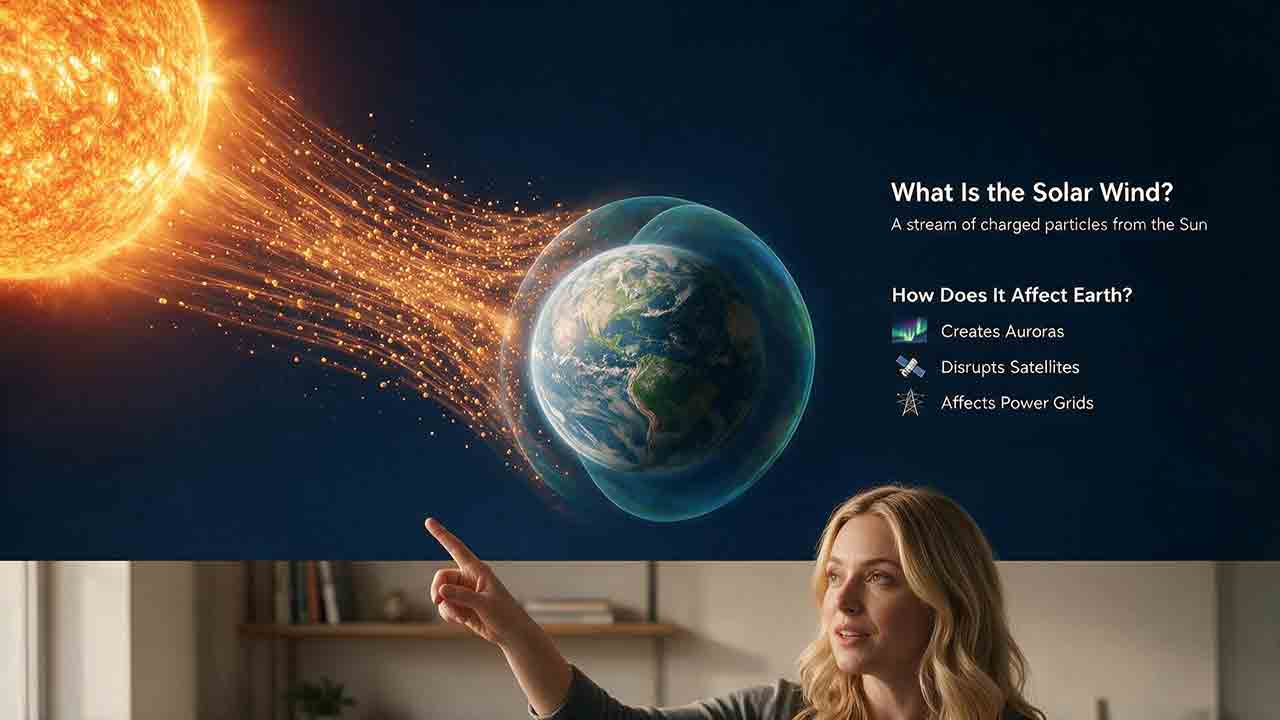
What Is the Solar Wind and How Does It Affect Earth?
The solar wind is a continuous stream of plasma and embedded magnetic fields flowing outward from the Sun. This article explains how that flow interacts with Earth’s magnetosphere and why solar-wind speed alone cannot predict the strength of a geomagnetic disturbance. Readers learn how proton density, dynamic pressure, magnetic-field strength, and southward Bz influence energy transfer into near-Earth space. The guide also distinguishes the solar wind from solar flares, coronal mass ejections, and solar energetic particles. Transparent travel-time and pressure calculations show how common measurements can be interpreted, while a practical decision framework explains how to read real-time NOAA data. The article also examines auroras, satellite drag, GPS accuracy, radio communication, power-grid effects, and the protection provided by Earth’s atmosphere and magnetic field. It emphasizes forecasting limits, data-quality checks, local viewing conditions, and the importance of relying on official space-weather alerts.
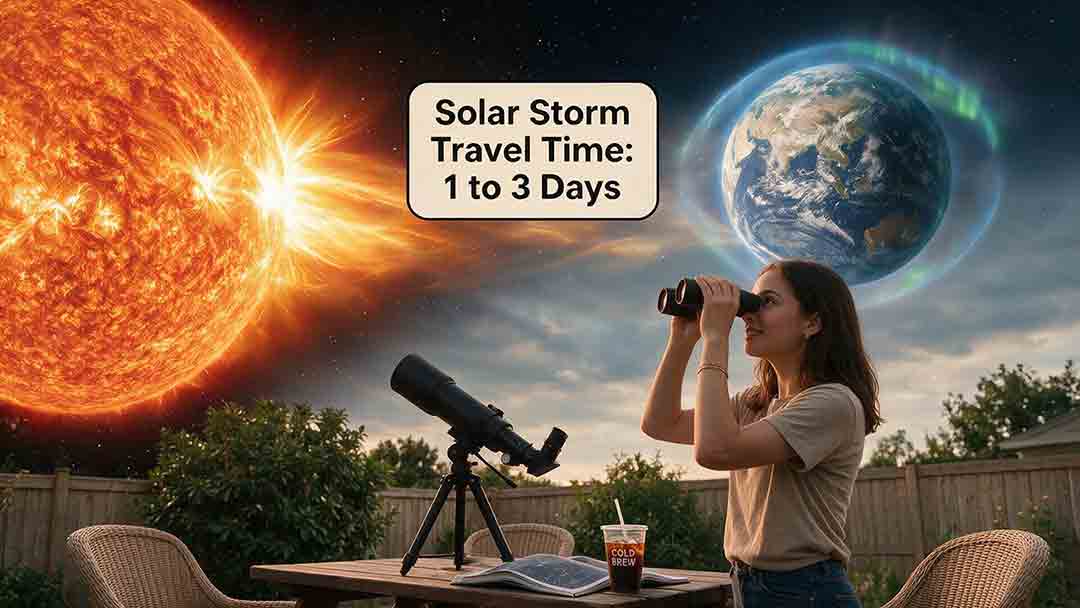
How Long Does a Solar Storm Take to Reach Earth?
A solar storm does not reach Earth on a single timetable because its radiation, energetic particles, and plasma travel at very different speeds. Solar-flare radiation arrives in about 8 minutes 20 seconds, while the fastest solar energetic particles can arrive in tens of minutes or less. An Earth-directed coronal mass ejection, or CME, generally takes one to several days, although exceptional events may arrive in roughly 15–18 hours. This guide introduces the Three-Clock, Two-Window Method for separating these timelines and understanding the difference between an early model forecast and short-term confirmation from spacecraft near the Sun–Earth L1 region. It also provides a transparent constant-speed calculation, real-world CME examples, common timing mistakes, and a practical process for interpreting official space-weather reports. Readers will learn why CME speed alone cannot determine arrival time, geomagnetic-storm strength, or whether aurora will be visible from a specific location.

Solar Flare vs Coronal Mass Ejection: What Is the Difference?
A solar flare and a coronal mass ejection are related solar events, but they are not the same phenomenon. A solar flare is a rapid burst of electromagnetic radiation that can affect Earth’s sunlit ionosphere within about eight minutes, sometimes disrupting high-frequency radio communication. A coronal mass ejection, or CME, is a large cloud of magnetized plasma that usually takes many hours or several days to reach Earth. If it is Earth-directed and carries favorable magnetic conditions, a CME may trigger a geomagnetic storm, expand auroral visibility, increase satellite drag, and affect navigation or power systems. This guide compares their composition, speed, arrival time, NOAA alert scales, and potential effects. It also introduces the Flash–Cloud–Compass framework, practical checklists, travel-time examples, and troubleshooting guidance to help readers interpret flare reports, CME forecasts, Bz measurements, Kp values, and aurora alerts without confusing one type of space-weather event with another.
Explore More Topics

How to Photograph the Northern Lights
Photographing the Northern Lights requires more than choosing one fixed camera setting. This practical guide explains how to select a camera and lens, focus accurately on stars, stabilize your equipment, and adjust shutter speed, aperture, and ISO according to the aurora’s brightness and movement. It includes starting settings for fast, moderate, and faint displays, along with a Motion–Brightness–Foreground framework that helps photographers make better decisions as conditions change. Readers will also learn how to use a smartphone Night mode, compose a stronger foreground, protect color-channel highlights, edit images responsibly, and disclose exposure blends clearly. A quick-reference card, three-frame comparison method, packing checklist, safety guidance, and detailed troubleshooting table make the article useful in the field. The guide relies on published guidance from NASA, NOAA, Nikon, Canon, and Apple while clearly distinguishing authoritative information from adjustable photography recommendations.
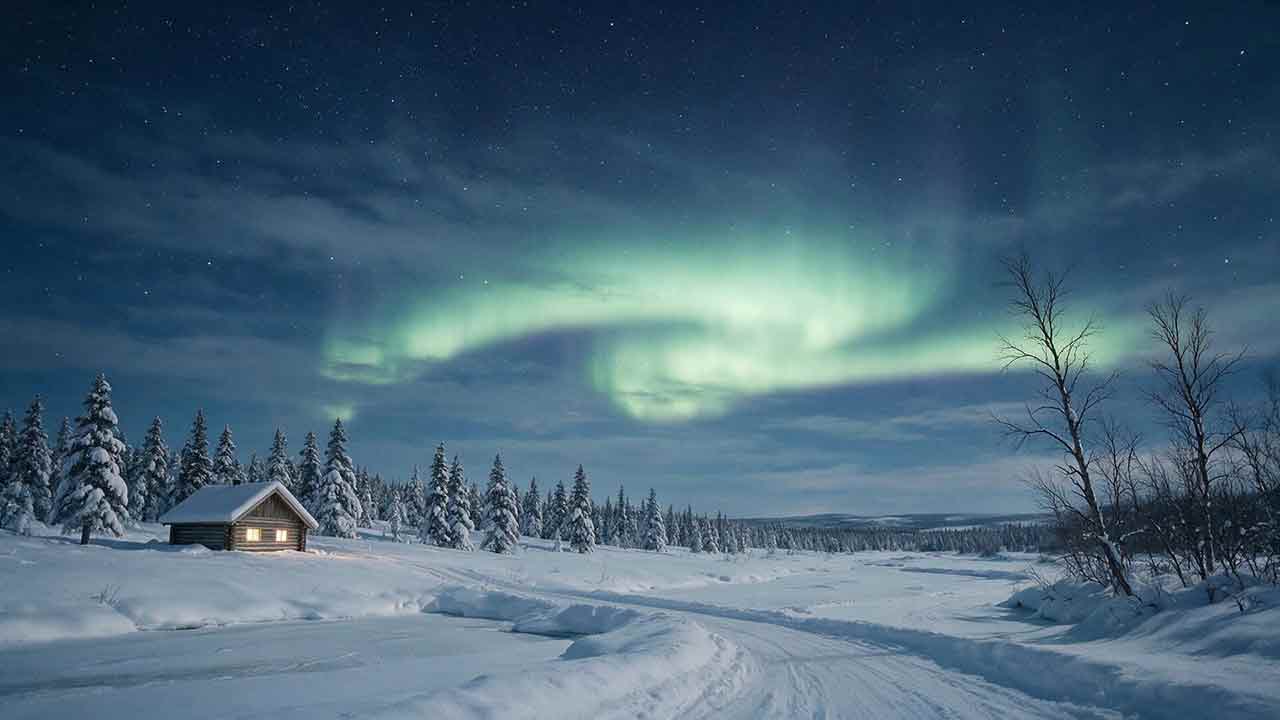
How Far South Can the Northern Lights Be Seen?
The northern lights usually remain within high-latitude regions, but powerful geomagnetic storms can carry visible aurora surprisingly far south. This guide explains why there is no single worldwide southern boundary and shows how geomagnetic latitude, the auroral oval, Kp, storm intensity, emission altitude, darkness, cloud cover, and local light pollution affect what an observer may see. It examines NOAA’s generalized U.S. visibility examples for G1 through G5 storms, while clarifying that locations such as Alabama, Florida, and southern Texas represent rare historical possibilities rather than guaranteed forecast limits. Readers will also find an original four-gate decision framework, an auditable geometric viewing-distance example, regional viewing guidance, a practical checklist, and troubleshooting advice for distinguishing faint aurora from clouds or artificial sky glow. The article helps observers decide when a forecast justifies going outside or traveling to a safer, darker viewing site.
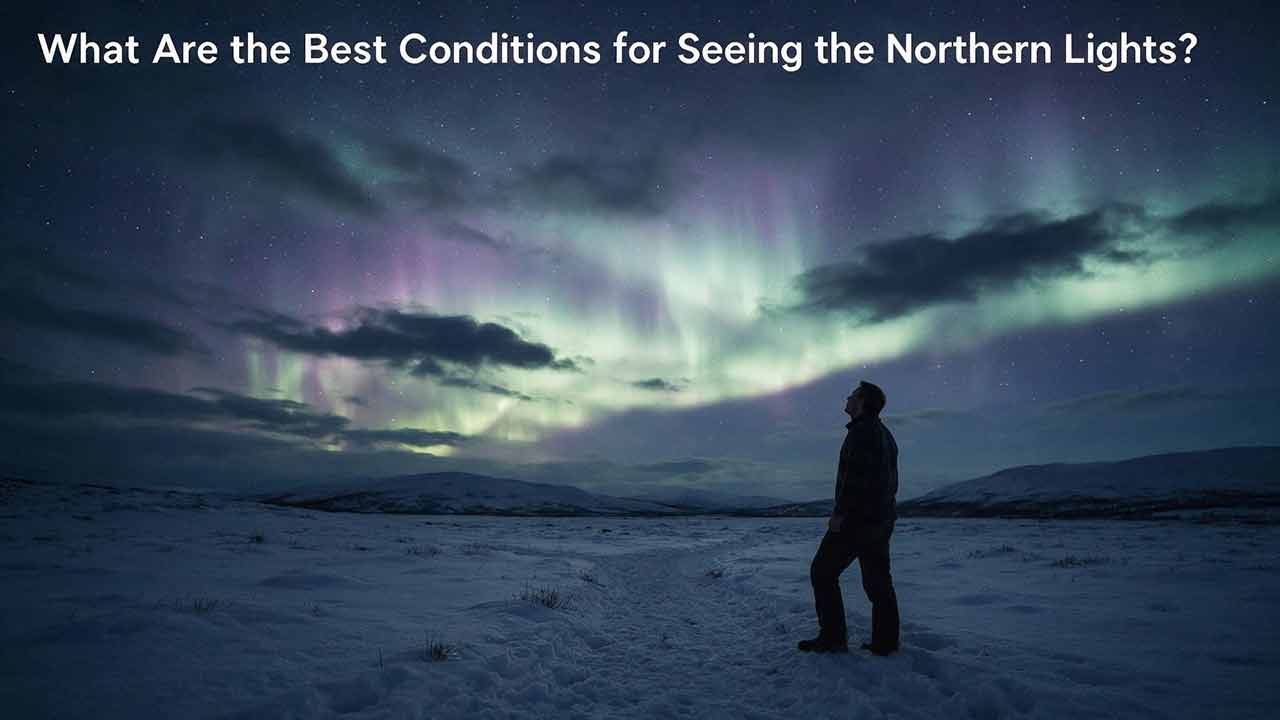
What Are the Best Conditions for Seeing the Northern Lights?
The best Northern Lights viewing conditions occur when geomagnetic activity, clear weather, darkness, and a suitable observing location align. This guide explains why the position of the auroral oval matters more than relying on a single Kp value and shows how cloud cover, twilight, light pollution, moonlight, atmospheric transparency, and horizon visibility affect what an observer can see. It introduces the Five-Gate Aurora Viewing Framework, a practical planning tool that evaluates aurora activity, clouds, darkness, location, and available viewing time without presenting the result as a guaranteed probability. Readers will also learn how to compare short- and long-range forecasts, convert UTC forecast periods, choose a safe dark-sky site, recognize faint aurora, and troubleshoot a promising forecast that produces no visible display. The article is based on guidance from NOAA, NASA, the University of Alaska Fairbanks, and the National Park Service.