How Long Does a Solar Storm Take to Reach Earth?

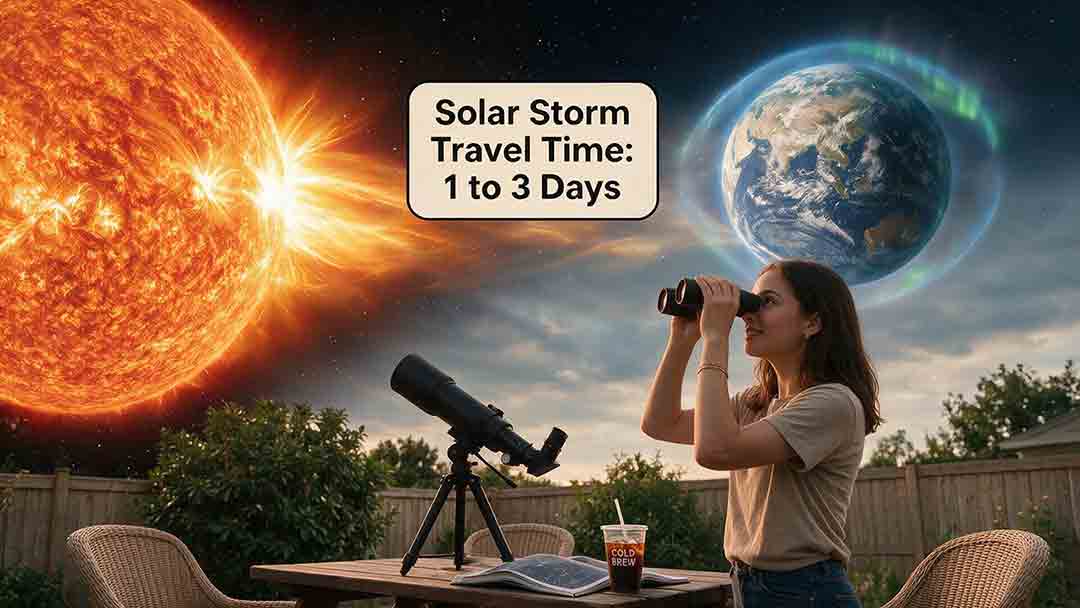
How Long Does a Solar Storm Take to Reach Earth?
A solar storm does not have one travel time. Solar-flare radiation reaches Earth in about 8 minutes 20 seconds. The fastest solar energetic particles can arrive in tens of minutes or less. An Earth-directed coronal mass ejection—the component most likely to drive a geomagnetic storm—usually takes one to several days, although exceptional events can arrive in roughly 15–18 hours.
Key Takeaways
- Solar-flare radiation reaches Earth at light speed in about eight minutes.
- The fastest solar energetic particles can arrive in tens of minutes or less.
- Exceptional Earth-directed coronal mass ejections can arrive in approximately 15–18 hours.
- Slower CMEs may take several days, and only CMEs that intersect Earth can produce a direct impact.
- CME arrival time alone cannot predict geomagnetic-storm strength or local aurora visibility.
This guide separates the three travel clocks inside a solar storm, provides a transparent CME travel-time calculation, and explains how to use official arrival forecasts without treating them as exact promises.
Which Part of a Solar Storm Is Reaching Earth?
“Solar storm” is an informal umbrella term. A report may be describing electromagnetic radiation from a solar flare, energetic charged particles, a coronal mass ejection, or the geomagnetic disturbance that develops after suitable solar-wind conditions reach Earth.
These phenomena are related, but they do not travel at the same speed.
| Component | Approximate travel time | What the timing means |
|---|---|---|
| Flare radiation | About 8 minutes 20 seconds | X-rays and extreme ultraviolet radiation can affect the sunlit ionosphere |
| Fast energetic particles | Tens of minutes or less | High-energy protons and electrons may alter the near-Earth radiation environment |
| Fast Earth-directed CME | About 15–18 hours | A shock, plasma, and embedded magnetic field may reach Earth |
| Slower CME | One to several days | Geomagnetic effects become possible if the CME intersects Earth |
| Upstream L1 confirmation | Often 15–60 minutes before Earth impact | Spacecraft confirm that a solar-wind disturbance is close |
NOAA reports that CMEs travel outward from the Sun at speeds ranging from below 250 kilometers per second to nearly 3,000 kilometers per second. The fastest Earth-directed events can arrive in approximately 15–18 hours, while slower CMEs may take several days. See NOAA’s explanation of coronal mass ejections.
Readers who need a clearer distinction between the first and third rows may also find Solar Flare vs CME: What Is the Difference? useful.
How Does the Three-Clock, Two-Window Method Work?
The Three-Clock, Two-Window Method separates what is physically traveling from how forecasters learn that it is approaching.
The three clocks describe radiation, energetic particles, and CME plasma. The two windows describe the longer model-based forecast and the shorter upstream confirmation period near Earth.
Clock 1: Solar-Flare Radiation
Solar-flare radiation reaches Earth in about 8 minutes 20 seconds.
A solar flare is a rapid release of electromagnetic radiation. Its X-rays and extreme ultraviolet radiation travel at the speed of light.
NASA lists the one-way Sun–Earth light time as approximately 8.35 minutes. The exact value changes slightly as Earth moves through its mildly elliptical orbit. See NASA’s facts about Earth.
By the time near-Earth instruments detect a flare, its radiation has already crossed interplanetary space. There is no additional multi-hour warning before the immediate ionospheric effects begin.
NOAA explains that flare radiation can affect the sunlit side of Earth’s outer atmosphere at essentially the same time the event is observed. See NOAA’s solar-flare and radio-blackout guide.
Clock 2: Solar Energetic Particles
The fastest solar energetic particles can arrive in tens of minutes or less.
These particles are mainly high-energy protons and electrons accelerated during major eruptions or by CME-driven shocks. Some travel at substantial fractions of the speed of light.
The highest-energy particles generally arrive first. Lower-energy populations may continue building later, and a solar radiation storm can persist for hours or days.
NOAA states that sufficiently energetic protons can cross the approximately 150-million-kilometer Sun–Earth distance in tens of minutes or less. See NOAA’s solar-radiation-storm guide.
This clock matters particularly to spacecraft operators, astronauts, polar aviation, satellite electronics, and high-latitude radio users.
Clock 3: Coronal Mass Ejection
A coronal mass ejection normally takes many hours to several days to reach Earth.
A coronal mass ejection, or CME, is a large expulsion of plasma and embedded magnetic field from the Sun’s corona. Unlike flare radiation, it contains matter and interacts with the surrounding solar wind throughout its journey.
An exceptionally fast Earth-directed CME may arrive in approximately 15–18 hours. A moderately fast event may require one or two days. Slower CMEs can take several days.
Direction matters as much as speed. A fast CME traveling away from Earth has no Earth-arrival time.
Window 1: The Model-Based Arrival Window
Coronagraph images allow forecasters to estimate a CME’s apparent speed, width, direction, and likely path.
Propagation models then calculate an expected arrival window. This can provide many hours or several days of advance notice, but it is not an exact appointment.
Uncertainty comes from projection effects, incomplete knowledge of the CME’s three-dimensional shape, changing speed, interactions with the solar wind, and encounters with earlier eruptions.
Window 2: Upstream Confirmation Near L1
Spacecraft near the Sun–Earth L1 region can detect an approaching CME-associated shock before it reaches Earth.
A sudden increase in solar-wind speed, density, temperature, or magnetic-field strength can often provide roughly 15–60 minutes of additional warning or confirmation. The available interval depends on solar-wind speed, spacecraft position, data availability, and which part of the disturbance is detected.
By this point, the question has changed from “Will the modeled disturbance arrive?” to “What plasma and magnetic field is it carrying?”
L1 measurements do not guarantee advance knowledge of the storm’s peak Kp, total duration, or local aurora visibility.
How Can You Estimate CME Travel Time?
A basic travel-time estimate uses:
Travel time = distance ÷ average speed
For this guide, the Sun–Earth distance is simplified to 149.6 million kilometers.
The calculation in hours is:
Travel time in hours = 149,600,000 ÷ (speed in km/s × 3,600)
This assumes that the CME travels directly toward Earth at one constant speed. Real CMEs rarely satisfy all three assumptions.
What Is the Quick Constant-Speed Rule?
A convenient mental estimate is:
Travel time in hours ≈ 41,556 ÷ CME speed in km/s
Examples:
- 500 km/s gives approximately 83 hours.
- 1,000 km/s gives approximately 41.6 hours.
- 1,500 km/s gives approximately 27.7 hours.
- 2,000 km/s gives approximately 20.8 hours.
Important: This is a constant-speed comparison rule, not an operational CME arrival forecast.
Use the CME speed estimated near the Sun. Do not substitute:
- a flare class such as M5 or X1;
- an energetic-particle speed;
- a value expressed in miles per second without converting it;
- a solar-wind speed measured near Earth after the disturbance has nearly completed its journey.
A near-Earth solar-wind measurement describes current local conditions. It should not be used to reconstruct the original forecast calculation.
What Travel Times Do Different CME Speeds Produce?
The following values were calculated for this guide using a Sun–Earth distance of 149.6 million kilometers.
| Assumed speed | Constant-speed time | Approximate duration |
|---|---|---|
| 250 km/s | 166.2 hours | 6.9 days |
| 400 km/s | 103.9 hours | 4.3 days |
| 500 km/s | 83.1 hours | 3.5 days |
| 800 km/s | 51.9 hours | 2.2 days |
| 1,000 km/s | 41.6 hours | 1.7 days |
| 1,500 km/s | 27.7 hours | 1.2 days |
| 2,000 km/s | 20.8 hours | 0.9 days |
| 2,500 km/s | 16.6 hours | 0.7 days |
| 3,000 km/s | 13.9 hours | 0.6 days |
The 3,000 km/s result does not mean forecasters should predict a 13.9-hour arrival. An eruption may not maintain its initial speed, may not be traveling directly toward Earth, and may be slowed by the surrounding solar wind.
Worked Example: A CME Reported at 1,500 km/s
Suppose coronagraph analysis gives an estimated CME speed of 1,500 kilometers per second.
149,600,000 km ÷ 1,500 km/s = 99,733 seconds ≈ 27.7 hours
The simplified result is approximately 28 hours.
An operational model may still produce an earlier or later window because the reported speed can be affected by viewing geometry, the CME may decelerate, and only part of the structure may be traveling toward Earth.
Why Can the Actual Arrival Differ From the Calculation?
Speed alone is not enough to estimate impact accurately.
The Reported Speed May Not Be the Earthward Speed
Coronagraph images show a two-dimensional projection of a three-dimensional eruption.
A CME moving partly toward or away from an observing spacecraft may appear slower, wider, or differently directed than it really is. A halo around the occulted Sun may indicate motion along the observer’s line of sight, but it does not prove a direct Earth impact.
Forecasters therefore consider eruption location, apparent width, speed, direction, and additional viewpoints when available.
A CME Can Accelerate or Decelerate
A CME travels through the solar wind rather than empty space.
A fast CME often pushes into slower material and decelerates. A slow CME may be accelerated toward the speed of the surrounding solar wind.
The speed measured near the Sun is therefore not necessarily the average speed over the full journey.
Earlier Eruptions Can Change the Route
A preceding CME can alter the interplanetary environment encountered by a later eruption.
Earlier material may clear part of the path, compress plasma ahead of the next event, or merge with it. These interactions can change arrival time, shock strength, magnetic structure, and storm duration.
NASA’s review of the July 2012 event describes how earlier eruptions had reduced the usual deceleration along its path. See NASA’s July 2012 solar-superstorm review.
“CME Arrival” Is Not One Sharp Moment
A CME is an extended structure, not a rigid object with one clean leading edge.
Forecasters may distinguish among:
- the CME-driven shock;
- the compressed sheath behind the shock;
- the main magnetic ejecta;
- trailing disturbed solar wind.
A forecasted arrival usually refers to the first shock or clear disturbance. The magnetic field most capable of driving a geomagnetic storm may arrive later.
How Accurate Are CME Arrival Forecasts?
CME forecasts can be early or late by several hours, and difficult events may produce substantially larger errors.
A comparative analysis of forecasts submitted to NASA’s Community Coordinated Modeling Center examined predictions from 32 models between 2013 and mid-2018. The study concerned CME-driven shock arrival times, not the later arrival of every part of the magnetic ejecta.
Across the models, predicted shock arrivals were within roughly 10 hours in an average sense, but the standard deviation of individual errors often exceeded 20 hours. The best-performing models had:
- mean bias close to zero—about one hour in magnitude;
- mean absolute error of approximately 13 hours;
- standard deviation of approximately 15 hours.
These measures describe different aspects of performance:
- Mean error, or bias, shows whether forecasts tend to be early or late overall.
- Mean absolute error shows the average size of the timing error without allowing early and late errors to cancel.
- Standard deviation shows how widely individual errors vary around the average.
In practical terms, a forecast that performs well on average can still be substantially early or late for one particular CME.
The findings should not be interpreted as a guaranteed plus-or-minus-10-hour uncertainty range for every event. See the NASA-hosted study, Forecasting the Arrival Time of Coronal Mass Ejections: Analysis of the CCMC CME Scoreboard.
How Does Forecast Confidence Improve as a CME Approaches?
Forecast confidence generally develops in six stages.
Stage 1: A Solar Eruption Is Detected
A flare, filament eruption, or other disturbance is observed.
Scientists may not yet know whether a CME was produced or whether it is traveling toward Earth.
Stage 2: A CME Appears in Coronagraph Images
Analysts estimate its apparent speed, width, and direction.
Earth-impact probability becomes easier to assess, although projection effects remain important.
Stage 3: Propagation Models Produce a Window
Models estimate whether the CME may intersect Earth and when its leading disturbance could arrive.
This is the main advance-planning stage.
Stage 4: Upstream Monitors Detect the Disturbance
Spacecraft near L1 record changes in solar-wind conditions.
The arrival is now being confirmed rather than inferred only from remote images.
Stage 5: The Magnetic Orientation Is Measured
The north–south magnetic-field component, commonly called Bz, becomes directly measurable as the disturbance passes the upstream monitor.
Sustained southward Bz favors stronger coupling with Earth’s magnetic field.
Stage 6: Earth’s Response Is Observed
Ground magnetometers, satellites, and indices such as Kp reveal how Earth’s magnetosphere is actually responding.
At this point, geomagnetic activity is being measured rather than merely forecast.
How Should You Read a Solar-Storm Arrival Forecast?
Step 1: Record the Eruption Time in UTC
Official space-weather reports normally use Coordinated Universal Time.
Keep the original UTC time before converting it. A conversion error can move the expected arrival onto the wrong calendar date.
Step 2: Identify the Event Type
Look for explicit terms:
- solar flare for electromagnetic radiation;
- solar energetic particle event for high-energy charged particles;
- coronal mass ejection for magnetized plasma;
- geomagnetic storm for Earth’s response.
A strong flare does not automatically mean an Earth-directed CME occurred.
Step 3: Check Whether Earth Is in the CME’s Path
Do not rely only on descriptions such as “large,” “fast,” or “halo CME.”
Look for an official assessment of:
- a likely direct impact;
- a possible flank impact;
- a low-confidence impact;
- no expected Earth impact.
Step 4: Treat the Prediction as a Window
Suppose a forecast gives an expected arrival of 12:00 UTC with an uncertainty of eight hours.
The useful monitoring period extends roughly from 04:00 to 20:00 UTC. The central time is not a deadline.
Step 5: Look for Upstream Confirmation
As the model window begins, follow official solar-wind observations and updated forecast discussions.
Increases in speed, density, temperature, pressure, or total magnetic-field strength may indicate that the CME-associated shock has reached the upstream monitoring point.
Step 6: Check Bz and Magnetic-Field Strength
CME speed is only part of the storm equation.
Sustained southward Bz allows more efficient energy transfer from the solar wind into Earth’s magnetosphere. A fast CME carrying mostly northward magnetic field may produce less activity than expected.
NOAA identifies sustained high-speed solar wind and, most importantly, a southward-directed magnetic field as key conditions for geomagnetic storms. See NOAA’s geomagnetic-storm guide.
Step 7: Separate Global Activity From Local Aurora Conditions
Kp describes broad geomagnetic activity. It does not guarantee aurora at a specific location.
Visibility also depends on:
- geomagnetic latitude;
- the position of the auroral oval;
- darkness;
- cloud cover;
- moonlight;
- light pollution;
- the timing of shorter substorms.
What Do Real Solar-Storm Travel Times Show?
Three well-documented events illustrate the useful range without turning the article into a historical catalogue.
January 2026: About 25 Hours to Earth
ESA reported an X-class flare on January 18, 2026, followed by an Earth-directed CME.
Initial models estimated a speed near 1,400 km/s. The CME reached Earth after approximately 25 hours, leading ESA to infer an average transit speed closer to 1,700 km/s.
The event is a modern example of a very fast CME reaching Earth in slightly more than one day. See ESA’s report on the January 2026 space-weather event.
July 2012: About 18.5 Hours to a Spacecraft Near 1 AU
The July 23, 2012 CME did not strike Earth.
It traveled toward NASA’s STEREO-A spacecraft, which occupied a different position in its orbit around the Sun. NASA-hosted research reports an approximately 18.5-hour shock transit to the spacecraft near Earth’s orbital distance.
The July 2012 record illustrates three important limitations:
- an extreme transit can approach the lower end of the observed range;
- earlier eruptions can reduce normal deceleration;
- reaching approximately one astronomical unit is not the same as striking Earth.
See The 2012 July 23 Backside Eruption.
August 2018: Roughly Five Days to Earth
A CME left the Sun on August 20, 2018. NASA reports that it reached Earth on August 25, with aurora observed into August 26.
The CME traveled comparatively slowly, but its strong southward magnetic component helped it produce a notable geomagnetic response.
The event shows why speed alone is not a measure of geoeffectiveness. See NASA’s analysis of the August 2018 CME.
| Event | Approximate transit | Main lesson |
|---|---|---|
| January 2026 Earth impact | About 25 hours | A fast CME can arrive in slightly more than one day |
| July 2012 STEREO-A encounter | About 18.5 hours to near 1 AU | Extreme speed does not mean the event struck Earth |
| August 2018 Earth impact | Roughly five days | A slow CME can still be geoeffective |
Does CME Arrival Automatically Cause a Geomagnetic Storm?
No. CME arrival does not automatically cause a geomagnetic storm.
The disturbance must intersect Earth, and its speed, density, pressure, magnetic-field strength, and magnetic orientation must support effective energy transfer into the magnetosphere.
Possible outcomes include:
- no detectable impact;
- a weak flank encounter;
- a shock with little sustained activity;
- a moderate geomagnetic storm;
- a strong storm supported by prolonged southward magnetic fields.
“CME arrival expected” and “major geomagnetic storm expected” are therefore not equivalent statements.
What Are the Most Common Solar-Storm Timing Mistakes?
Assuming the Entire Storm Arrives in Eight Minutes
Only electromagnetic radiation travels from the Sun to Earth in about eight minutes.
Energetic particles occupy an intermediate timescale, while the CME generally requires many hours or days.
Treating Flare Class as CME Speed
An X-class flare describes soft X-ray intensity.
It does not state whether a CME occurred, how fast it is traveling, whether it is Earth-directed, or how strong a later geomagnetic storm will become.
Assuming Every Halo CME Will Hit Earth
A halo appearance can result from material moving toward or away from the observing spacecraft.
Eruption location, width, direction, and propagation modeling must also be considered.
Treating the Initial Speed as Constant
A CME reported at 1,500 km/s near the Sun may not average 1,500 km/s throughout its journey.
Fast events commonly decelerate. Slower events may be accelerated toward the ambient solar-wind speed.
Treating the Forecast Time as a Deadline
An arrival prediction is a window.
Checking only at the central forecast time may cause a reader to miss an early or late arrival.
Assuming CME Arrival Guarantees Aurora
Aurora depends on the geomagnetic response, the observer’s latitude, darkness, clouds, the auroral oval, and other local conditions.
Why Might the Forecast and Observed Result Differ?
No Clear CME Arrival Appears
The CME may have missed Earth, delivered only a weak flank, or blended into the background solar wind.
Check the latest official forecast discussion rather than relying on the first public report.
The CME Arrives Earlier Than Predicted
It may have decelerated less than expected, traveled through a preconditioned region, or contained a faster Earthward component than the initial imagery revealed.
The CME Arrives Later Than Predicted
Greater deceleration, uncertain viewing geometry, CME–CME interaction, or an inaccurate Earthward-speed estimate may delay the observed shock.
The Shock Arrives but Kp Remains Low
The disturbance may carry a weak magnetic field, mostly northward Bz, or only a brief interval of southward Bz.
Kp Rises but No Aurora Is Visible Locally
The auroral oval may remain too far poleward, or local skies may be bright, cloudy, or affected by light pollution.
A Radio Blackout Occurs Before the CME Arrives
Flare radiation reached Earth at light speed. The radio blackout and later CME arrival are separate phases.
Forecast updates are a normal part of space-weather operations. New imagery and upstream measurements replace earlier assumptions with better information.
Who Is This Article For?
This guide is intended for:
- readers trying to understand a solar-storm news report;
- aurora watchers interpreting a CME arrival window;
- students comparing flares, particles, and CMEs;
- radio users separating flare effects from later CME effects;
- readers using NOAA, NASA, or ESA information.
It is not an operational manual for satellite control, astronaut safety, aviation dispatch, electric-grid management, emergency response, or communications infrastructure.
Organizations responsible for safety-critical systems should follow official alerts and approved internal procedures.
What Should You Do After an Earth-Directed CME Is Announced?
For General Readers
Identify whether the announcement concerns a flare, energetic particles, a CME, or several components.
Do not assume that “solar storm” refers to one object or one arrival time.
For Aurora Watchers
Use this checklist:
- Confirm that official analysis indicates a possible Earth impact.
- Record the full arrival window in UTC.
- Convert the window carefully to local time.
- Monitor official solar-wind data when the window begins.
- Look for sustained southward Bz.
- Check the Kp outlook and auroral oval.
- Compare the space-weather outlook with local darkness and cloud cover.
No forecast can guarantee a local aurora sighting.
For Radio Users
Pay attention immediately after a strong flare.
X-ray-driven radio blackouts do not wait for the CME. Energetic particles and later geomagnetic activity can create additional effects on different timescales.
For Professional Operators
Use official warnings, organization-specific thresholds, and established response plans.
A public educational guide cannot account for the engineering limits, redundancy, geographic exposure, or operating procedures of a particular system.
What Is the Practical Answer?
The most useful working answer is:
- about 8 minutes 20 seconds for solar-flare radiation;
- tens of minutes or less for the fastest energetic particles;
- approximately 15–18 hours to several days for an Earth-directed CME.
For geomagnetic-storm and aurora planning, the CME timeline is normally the most relevant.
Start with the official model-based arrival window. As that window approaches, use upstream solar-wind measurements to confirm the disturbance and magnetic-field measurements to assess whether stronger geomagnetic activity is becoming more likely.
Frequently Asked Questions
Can a solar storm reach Earth in eight minutes?
Solar-flare radiation reaches Earth in about eight minutes because it travels at the speed of light. The CME’s plasma and magnetic field normally require many hours or several days.
What is the fastest a CME can reach Earth?
NOAA states that the fastest Earth-directed CMEs can arrive in approximately 15–18 hours. These are exceptional events rather than typical travel times.
How much warning do we receive before a geomagnetic storm?
Initial CME observations may provide many hours or several days of notice. Upstream monitors near L1 can often provide roughly 15–60 minutes of additional warning or confirmation before the shock reaches Earth.
Does every CME reach Earth?
No. A CME may travel in another direction, pass above or below Earth, or deliver only a weak flank encounter.
Can scientists predict storm strength before the CME arrives?
Scientists can estimate a possible range, but the CME’s internal magnetic orientation remains a major uncertainty. The most useful direct Bz measurements usually become available only when the disturbance reaches upstream monitors near Earth.
Does an arriving CME guarantee visible aurora?
No. The CME must produce sufficient geomagnetic activity, and the observer must also have a suitable latitude, darkness, weather, and view of the auroral oval.
Sources
NOAA Space Weather Prediction Center — Coronal Mass Ejections
CME speed ranges, fastest Earth-arrival times, propagation analysis, L1 confirmation, and magnetic-field considerations.NOAA Space Weather Prediction Center — Solar Flares and Radio Blackouts
Speed-of-light flare propagation and immediate ionospheric effects.NOAA Space Weather Prediction Center — Solar Radiation Storm
Energetic-particle travel times and solar-radiation-storm duration.NOAA Space Weather Prediction Center — Geomagnetic Storms
Geomagnetic-storm formation and the importance of sustained southward magnetic fields.NASA Science — Facts About Earth
Sun–Earth distance and one-way light-travel time.NASA Technical Reports Server — Forecasting the Arrival Time of Coronal Mass Ejections
CME-shock forecasting statistics, including mean error, mean absolute error, and standard deviation.ESA — Monitoring the January 2026 Space-Weather Event
The January 2026 flare, initial CME speed estimate, and approximately 25-hour Earth arrival.NASA Science — Near Miss: The Solar Superstorm of July 2012
The STEREO-A encounter and the influence of preceding eruptions.NASA Technical Reports Server — The 2012 July 23 Backside Eruption
The approximately 18.5-hour shock transit near one astronomical unit.NASA Science — Here’s a Coronal Mass Ejection Right Before It Hit Earth
The August 2018 timeline, DSCOVR observations, and geomagnetic response.
How This Article Was Reviewed
This article was checked against first-party information from NOAA, NASA, ESA, and NASA-hosted technical literature. The source review was completed on August 3, 2026.
The speed table and worked example were calculated for this guide using a simplified Sun–Earth distance of 149.6 million kilometers. They assume direct, constant-speed travel and are not substitutes for operational CME-propagation models.
The forecast-accuracy section identifies the study period, number of models, predicted phenomenon, and differences among mean error, mean absolute error, and standard deviation. The statistics are presented as multi-event performance measures rather than a guaranteed uncertainty range for one CME.
The historical examples were checked against agency event reports or NASA-hosted research records. The July 2012 event is described as a spacecraft encounter near one astronomical unit, not an Earth impact.
This article should be reviewed again if the cited agencies materially revise their public guidance on CME travel times, upstream warning intervals, or forecasting performance.
What This Article Does Not Claim
This article does not provide a live solar-storm forecast.
It does not guarantee that a CME will reach Earth, predict an exact geomagnetic-storm peak, or promise that aurora will be visible from a particular location.
Current decisions should be based on official space-weather alerts, updated observations, and approved organizational procedures where safety-critical systems are involved.
More from Solar Storms & Space Weather

What Is the Solar Wind and How Does It Affect Earth?
The solar wind is a continuous stream of plasma and embedded magnetic fields flowing outward from the Sun. This article explains how that flow interacts with Earth’s magnetosphere and why solar-wind speed alone cannot predict the strength of a geomagnetic disturbance. Readers learn how proton density, dynamic pressure, magnetic-field strength, and southward Bz influence energy transfer into near-Earth space. The guide also distinguishes the solar wind from solar flares, coronal mass ejections, and solar energetic particles. Transparent travel-time and pressure calculations show how common measurements can be interpreted, while a practical decision framework explains how to read real-time NOAA data. The article also examines auroras, satellite drag, GPS accuracy, radio communication, power-grid effects, and the protection provided by Earth’s atmosphere and magnetic field. It emphasizes forecasting limits, data-quality checks, local viewing conditions, and the importance of relying on official space-weather alerts.
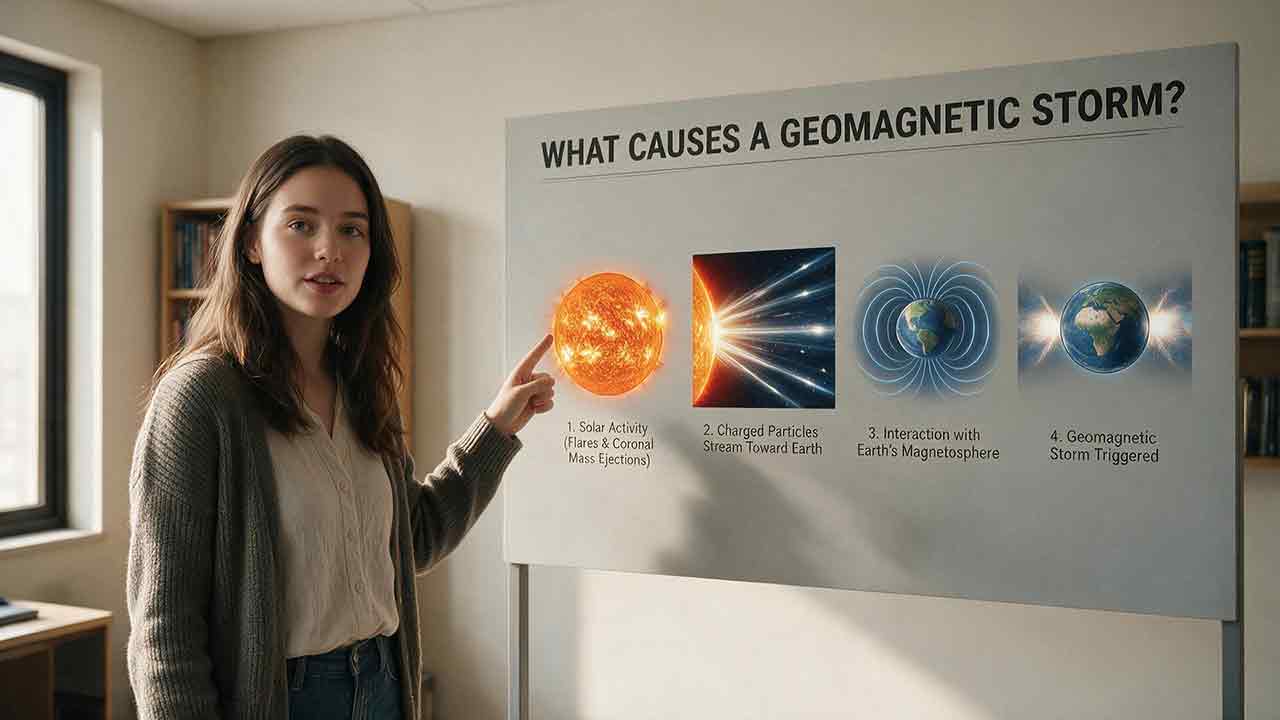
What Causes a Geomagnetic Storm?
A geomagnetic storm develops when a magnetized disturbance in the solar wind reaches Earth and transfers substantial energy into the magnetosphere. This guide explains the two main source pathways: Earth-directed coronal mass ejections, including their shocks and sheath regions, and high-speed solar-wind streams produced by coronal holes and co-rotating interaction regions. It shows why sustained southward Bz is often more important than solar-wind speed or flare class alone, and how magnetic reconnection intensifies currents and particle activity around Earth. The article also introduces a practical Four-Question Storm Potential Test, a transparent coupling calculation, a storm-potential matrix, and a forecast-reading checklist. Readers will learn how Kp, Dst, and local magnetic changes describe different parts of a storm, why forecasts remain uncertain, and how geomagnetic activity may affect auroras, satellites, navigation, radio communication, atmospheric drag, and grounded long-conductor systems.

Solar Flare vs Coronal Mass Ejection: What Is the Difference?
A solar flare and a coronal mass ejection are related solar events, but they are not the same phenomenon. A solar flare is a rapid burst of electromagnetic radiation that can affect Earth’s sunlit ionosphere within about eight minutes, sometimes disrupting high-frequency radio communication. A coronal mass ejection, or CME, is a large cloud of magnetized plasma that usually takes many hours or several days to reach Earth. If it is Earth-directed and carries favorable magnetic conditions, a CME may trigger a geomagnetic storm, expand auroral visibility, increase satellite drag, and affect navigation or power systems. This guide compares their composition, speed, arrival time, NOAA alert scales, and potential effects. It also introduces the Flash–Cloud–Compass framework, practical checklists, travel-time examples, and troubleshooting guidance to help readers interpret flare reports, CME forecasts, Bz measurements, Kp values, and aurora alerts without confusing one type of space-weather event with another.
Explore More Topics

How to Photograph the Northern Lights
Photographing the Northern Lights requires more than choosing one fixed camera setting. This practical guide explains how to select a camera and lens, focus accurately on stars, stabilize your equipment, and adjust shutter speed, aperture, and ISO according to the aurora’s brightness and movement. It includes starting settings for fast, moderate, and faint displays, along with a Motion–Brightness–Foreground framework that helps photographers make better decisions as conditions change. Readers will also learn how to use a smartphone Night mode, compose a stronger foreground, protect color-channel highlights, edit images responsibly, and disclose exposure blends clearly. A quick-reference card, three-frame comparison method, packing checklist, safety guidance, and detailed troubleshooting table make the article useful in the field. The guide relies on published guidance from NASA, NOAA, Nikon, Canon, and Apple while clearly distinguishing authoritative information from adjustable photography recommendations.

How Far South Can the Northern Lights Be Seen?
The northern lights usually remain within high-latitude regions, but powerful geomagnetic storms can carry visible aurora surprisingly far south. This guide explains why there is no single worldwide southern boundary and shows how geomagnetic latitude, the auroral oval, Kp, storm intensity, emission altitude, darkness, cloud cover, and local light pollution affect what an observer may see. It examines NOAA’s generalized U.S. visibility examples for G1 through G5 storms, while clarifying that locations such as Alabama, Florida, and southern Texas represent rare historical possibilities rather than guaranteed forecast limits. Readers will also find an original four-gate decision framework, an auditable geometric viewing-distance example, regional viewing guidance, a practical checklist, and troubleshooting advice for distinguishing faint aurora from clouds or artificial sky glow. The article helps observers decide when a forecast justifies going outside or traveling to a safer, darker viewing site.

What Are the Best Conditions for Seeing the Northern Lights?
The best Northern Lights viewing conditions occur when geomagnetic activity, clear weather, darkness, and a suitable observing location align. This guide explains why the position of the auroral oval matters more than relying on a single Kp value and shows how cloud cover, twilight, light pollution, moonlight, atmospheric transparency, and horizon visibility affect what an observer can see. It introduces the Five-Gate Aurora Viewing Framework, a practical planning tool that evaluates aurora activity, clouds, darkness, location, and available viewing time without presenting the result as a guaranteed probability. Readers will also learn how to compare short- and long-range forecasts, convert UTC forecast periods, choose a safe dark-sky site, recognize faint aurora, and troubleshoot a promising forecast that produces no visible display. The article is based on guidance from NOAA, NASA, the University of Alaska Fairbanks, and the National Park Service.