Can Solar Storms Damage Satellites?

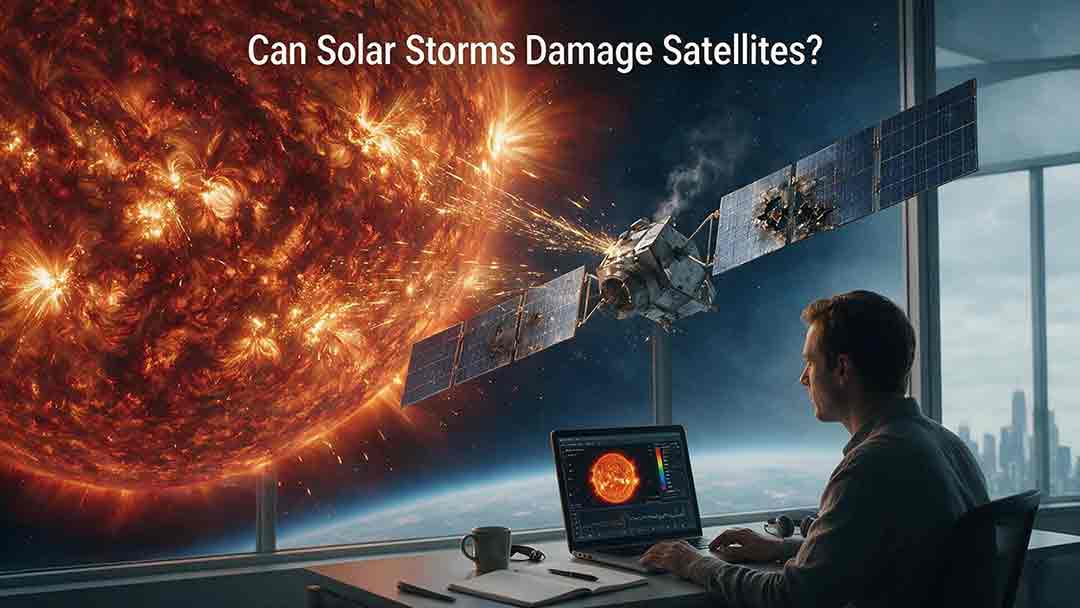
Can Solar Storms Damage Satellites?
Yes. Solar storms can damage satellites by upsetting electronics, causing surface or internal electrical discharges, degrading solar cells and sensors, and increasing atmospheric drag in low Earth orbit. Most events cause recoverable anomalies rather than sudden destruction, but the combination of a severe environment, vulnerable hardware, and a critical mission phase can lead to permanent damage or satellite loss.
Key Takeaways
- Solar storms can cause temporary software errors, permanent component damage, unexpected orbital decay, or—in unusual cases—the loss of a satellite.
- Different space-weather events create different hazards. Solar energetic particles mainly threaten electronics, while geomagnetic storms can intensify charging and increase atmospheric drag.
- Low Earth orbit satellites are especially sensitive to storm-driven atmospheric expansion. Medium Earth orbit and geostationary satellites face greater radiation-belt and charging concerns.
- Orbit, spacecraft design, mission phase, storm duration, and recovery capability matter more than a storm label alone.
- Radiation-tolerant electronics, electrical grounding, shielding, redundancy, safe modes, and space-weather monitoring reduce risk but do not make a satellite immune.
This article explains how solar storms damage satellites, which spacecraft are most exposed, what the 2022 Starlink loss teaches, and how engineers and operators assess risk without treating every solar eruption as the same threat.
How Can Solar Storms Damage Satellites?
Solar storms can affect satellites through four main pathways: energetic-particle radiation, spacecraft charging, atmospheric drag, and disruption of sensors or communications.
“Solar storm” is a convenient general term, but it can refer to several related events that do not damage spacecraft through the same physical process.
- A solar flare is a rapid release of electromagnetic radiation from the Sun. Its most immediate effects are usually radio blackouts and changes in the sunlit ionosphere.
- A coronal mass ejection, or CME, is an eruption of magnetized plasma. An Earth-directed CME can drive a geomagnetic storm if its speed and magnetic-field orientation favor strong interaction with Earth’s magnetosphere.
- A solar energetic particle event sends high-energy protons, electrons, and heavier ions through space. These particles can penetrate spacecraft materials and disturb electronics.
- A geomagnetic storm is a disturbance of Earth’s magnetic environment. It can alter radiation-belt populations, increase charging hazards, and heat the upper atmosphere.
The distinction matters. A bright solar flare does not automatically mean a satellite will suffer hardware damage, and a geomagnetic storm does not necessarily imply a severe solar radiation storm. The NOAA Space Weather Scales therefore use separate G scales for geomagnetic storms, S scales for solar radiation storms, and R scales for radio blackouts.
Which Damage Mechanism Produces Which Symptom?
| Hazard | Physical process | Possible first symptom | Possible mission consequence |
|---|---|---|---|
| Single-event effect | One energetic particle deposits charge in a semiconductor | Bit flip, false command, processor interruption | Automatic correction, reset, safe mode, or component failure |
| Surface charging | Different exterior surfaces reach different electrical potentials | Sensor noise, false signal, electrostatic arc | Temporary anomaly or damage to exposed materials and circuits |
| Internal charging | Energetic electrons accumulate in insulating materials inside the spacecraft | Delayed discharge near cables or circuit boards | Intermittent faults or permanent electrical damage |
| Total radiation dose | Repeated radiation exposure changes material or semiconductor properties | Rising leakage current or declining performance | Shorter component life or gradual subsystem failure |
| Displacement damage | Particle impacts alter a material’s atomic structure | Reduced detector sensitivity or solar-cell output | Declining instrument or power performance |
| Atmospheric drag | A geomagnetic storm heats and expands the thermosphere | Faster-than-predicted altitude loss | Extra fuel use, tracking uncertainty, early reentry |
| Sensor interference | Particles strike imaging detectors or star trackers | Bright pixels, streaks, or false stars | Reduced pointing accuracy or loss of attitude knowledge |
| Link disruption | Solar radiation and ionospheric changes affect radio propagation | Weak or unavailable command, telemetry, or navigation signals | Delayed operations or reduced service accuracy |
Not all of these effects are caused exclusively by solar storms. Galactic cosmic rays and Earth’s trapped radiation belts also contribute to the radiation environment throughout a mission. Solar activity can temporarily intensify particular hazards or change where and when they are encountered.
Can Solar Radiation Permanently Damage Satellite Electronics?
Yes. Energetic particles can permanently damage satellite electronics, although temporary and recoverable errors are more common.
When a proton, heavy ion, or secondary particle passes through a semiconductor, it can deposit enough charge to alter the state of a memory cell, processor, power device, or sensor. Engineers group these effects under the term single-event effects.
What Is a Single-Event Upset?
A single-event upset, or SEU, is a radiation-induced change in stored data or logic state. It may flip a memory bit, corrupt a calculation, change a sensor reading, or interrupt a software process.
An SEU is usually considered a “soft” error because the affected hardware may remain physically usable. A spacecraft can often recover through:
- error-detecting and error-correcting memory;
- memory scrubbing;
- watchdog timers;
- processor resets;
- redundant computers;
- comparison of duplicate calculations;
- restoration of a known-good software state.
An ESA analysis of ten years of Swarm satellite data documented radiation-related memory bit flips in three Earth-observation spacecraft. The satellites were designed to detect and manage such errors, illustrating that radiation effects can be measurable without ending a mission.
Which Single-Event Effects Are More Serious?
Some particle-induced events can produce permanent or potentially destructive outcomes:
- Single-event latch-up: an unintended high-current state develops inside a component.
- Single-event burnout: a power device suffers destructive electrical failure.
- Single-event gate rupture: an insulating layer in a semiconductor is damaged.
- Single-event functional interrupt: a device stops operating correctly until it is reset or power-cycled.
- Stuck bit: a memory location can no longer change state normally.
Whether a particle strike becomes a harmless corrected bit flip or a mission-ending failure depends on the component, circuit design, particle energy, shielding, operating voltage, fault protection, and the function performed by the affected hardware.
Radiation qualification is therefore application-specific. A component that is acceptable for a short low Earth orbit mission may not be suitable for years of operation in medium Earth orbit or deep space.
How Does Spacecraft Charging Cause Damage?
Spacecraft charging becomes dangerous when different parts of a satellite develop large electrical-potential differences and the accumulated charge discharges through an unintended path.
A satellite does not need to be completely uncharged to operate safely. The engineering objective is to control where charge accumulates, provide conductive paths for charge dissipation, and prevent discharges from crossing sensitive circuits or materials.
How Does Surface Charging Occur?
Surface charging affects exterior spacecraft materials exposed to the surrounding plasma. Sunlit and shadowed surfaces may charge differently. Conductive metals, thermal-control coatings, solar-array materials, paints, and insulating films can also respond differently.
If the voltage difference becomes large enough, an electrostatic discharge may:
- generate a false command;
- interfere with a sensor;
- reset a computer;
- damage a surface coating;
- create electromagnetic noise;
- arc across a solar array;
- damage an electronic component.
NASA’s overview of spacecraft charging hazards describes how electrostatic discharge can interfere with command systems, attitude control, sensors, communications, and spacecraft power hardware.
How Does Internal Charging Differ?
Internal charging, sometimes called deep-dielectric charging, occurs when energetic electrons penetrate the outer structure and become trapped in insulating materials inside the spacecraft.
Potential accumulation sites include:
- cable insulation;
- circuit-board substrates;
- connectors;
- adhesives;
- thermal blankets;
- dielectric materials near electronic assemblies.
The charge may accumulate over an extended period before discharging. That delay can make diagnosis difficult because an electrical anomaly may occur after the peak external particle environment has passed.
Internal charging is particularly important for spacecraft exposed to energetic electrons in or near Earth’s outer radiation belt, including many satellites in medium Earth orbit and geostationary orbit.
Why Do Geomagnetic Storms Increase Satellite Drag?
Geomagnetic storms deposit energy into Earth’s upper atmosphere. The thermosphere becomes hotter, expands upward, and increases in density at some satellite altitudes.
A satellite in low Earth orbit then collides with more atmospheric particles. The atmosphere remains extremely thin, but orbital velocity is high enough for a density increase to produce meaningful additional drag.
NASA explains that storm-driven atmospheric expansion can alter satellite trajectories, consume propulsion reserves, shorten orbital lifetime, and increase uncertainty in collision-risk calculations. The effect depends not only on storm intensity but also on storm duration, satellite altitude, spacecraft shape, and atmospheric-model accuracy.
What Does the Drag Equation Show?
A simplified expression for drag acceleration is:
[
a_D=\frac{1}{2}\rho v^2 C_D\frac{A}{m}
]
where:
- (a_D) is drag acceleration;
- (\rho) is atmospheric density;
- (v) is the spacecraft’s velocity relative to the atmosphere;
- (C_D) is the drag coefficient;
- (A) is the effective cross-sectional area;
- (m) is spacecraft mass.
The equation provides two useful proportional relationships:
- If atmospheric density doubles while the other terms remain approximately constant, drag acceleration also doubles.
- A satellite with a larger area-to-mass ratio experiences more drag acceleration under the same assumed conditions.
An Illustrative Area-to-Mass Comparison
Consider two hypothetical satellites at the same altitude, moving through the same atmospheric environment with the same assumed drag coefficient.
| Parameter | Satellite A | Satellite B |
|---|---|---|
| Mass | 500 kg | 100 kg |
| Area facing the airflow | 5 m² | 5 m² |
| Area-to-mass ratio | 0.01 m²/kg | 0.05 m²/kg |
| Relative drag sensitivity | 1× | 5× |
Satellite B has five times Satellite A’s area-to-mass ratio. Under the simplified assumptions above, Satellite B would experience approximately five times as much drag acceleration.
This is an original proportional example for explaining sensitivity. It does not estimate an actual altitude loss, reentry date, collision probability, or fuel requirement. A mission-level prediction would also require current density data, altitude, latitude, local solar time, attitude, atmospheric winds, storm duration, ballistic properties, and model uncertainty.
Which Satellites Are Most Vulnerable?
No single orbit is the most vulnerable to every solar-storm effect. Different orbits expose spacecraft to different combinations of radiation, charging, atmospheric density, and magnetic shielding.
How Does Risk Change by Orbit?
| Orbit or mission type | Main solar-storm concerns | Important vulnerability factors |
|---|---|---|
| Very low Earth orbit | Rapidly changing drag and orbital decay | High area-to-mass ratio, low deployment altitude, limited propulsion |
| Low Earth orbit | Drag, polar radiation exposure, sensor noise, communication disruption | Altitude, inclination, attitude control, fuel reserve |
| Medium Earth orbit | Radiation belts, internal charging, accumulated dose | Shielding, component selection, fault tolerance |
| Geostationary orbit | Surface charging, internal charging, communication and attitude anomalies | Grounding, materials, redundant control systems |
| Highly elliptical orbit | Repeated radiation-belt crossings and changing plasma conditions | Trajectory, time spent in hazardous regions, shielding distribution |
| Polar orbit | Greater access for energetic particles near magnetic-field regions | Inclination, sensor design, memory protection |
| Lunar or deep-space mission | Solar energetic particles with less protection from Earth’s magnetosphere | Radiation monitoring, autonomous recovery, shielding strategy |
Why Does Low Earth Orbit Still Carry Significant Risk?
Earth’s magnetic field provides partial protection in low Earth orbit, but that does not eliminate exposure.
Low-orbiting satellites may encounter:
- storm-driven atmospheric drag;
- energetic particles at high magnetic latitudes;
- enhanced exposure near the South Atlantic Anomaly;
- sensor interference;
- changes in communication and navigation conditions.
A spacecraft deployed into a low initial orbit may be especially vulnerable. It may not yet have reached its operational altitude, stable attitude, full power configuration, or normal orbit-raising capability.
Why Are Higher Orbits Different?
Atmospheric drag becomes negligible at medium Earth orbit and geostationary altitudes, but radiation and charging risks become more prominent.
Satellites in these regions can spend extended periods in energetic electron and proton environments. A fault may not produce visible orbital decay, but it can affect:
- computers;
- power electronics;
- solar arrays;
- star trackers;
- communications equipment;
- dielectric materials;
- long-term component reliability.
What Happened to the Starlink Satellites in February 2022?
The February 2022 Starlink loss demonstrates how a geomagnetic storm can contribute to satellite loss through atmospheric drag rather than by directly burning out spacecraft electronics.
SpaceX launched 49 satellites on February 3, 2022, into low initial orbits. A peer-reviewed study available through the NOAA Institutional Repository reported that 38 of the 49 satellites were subsequently lost because enhanced neutral atmospheric density increased drag.
The study’s simulations indicated a substantial density enhancement at relevant low Earth orbit altitudes during the minor-to-moderate but prolonged geomagnetic disturbance. The newly launched satellites had not yet reached their intended operational altitude.
What Does the Event Actually Prove?
The incident supports three limited conclusions:
- A storm does not need to be historically extreme to cause serious losses. Vulnerability and mission timing matter.
- Atmospheric drag can be the decisive mechanism. The satellites were not simply “fried” by radiation.
- Deployment is a high-consequence mission phase. A spacecraft in a low initial orbit may have less time and altitude margin for recovery.
The event does not prove that every moderate geomagnetic storm will destroy low Earth orbit satellites. Most operational spacecraft occupy different altitudes, have different ballistic properties, and may have more propulsion or recovery margin.
Can a Solar Storm Knock a Satellite Out of Orbit?
A solar storm can accelerate the orbital decay of a low Earth orbit satellite, but it usually does not push a stable operational spacecraft out of orbit in a single instant.
The sequence is:
- A geomagnetic storm heats and expands the upper atmosphere.
- Atmospheric density increases at the spacecraft’s altitude.
- Additional drag removes orbital energy.
- The satellite loses altitude faster than expected.
- Lower altitude exposes it to still denser atmosphere.
- Without sufficient propulsion or altitude margin, decay can become difficult to reverse.
For most operational satellites, the immediate concerns are additional fuel use, shorter mission life, orbit-prediction error, and reduced maneuvering margin. Premature reentry becomes more plausible for spacecraft already operating unusually low or lacking propulsion.
Can Solar Storms Disrupt Satellite Attitude Control?
Yes. Energetic particles, charging events, sensor interference, and computer errors can affect the systems that determine and control spacecraft orientation.
Many satellites use star trackers, which compare observed star patterns with an onboard catalog. A particle striking a detector can produce bright pixels, streaks, or false points that resemble stars.
Depending on the tracker and its software, the spacecraft may:
- reject the false detections;
- temporarily report lower confidence;
- switch to another attitude sensor;
- lose its attitude solution;
- enter safe mode.
Attitude errors can create secondary consequences. A satellite that cannot maintain its intended orientation may lose communication, reduce solar-array power, expose sensitive instruments, or present a larger cross-sectional area to the atmosphere.
Does Every Satellite Experience the Same Risk?
No. Storm strength alone cannot determine whether a satellite will be damaged.
Two spacecraft in similar orbits may respond differently because of differences in:
- component radiation tolerance;
- shielding geometry;
- grounding and bonding;
- surface materials;
- electrical layout;
- memory correction;
- solar-array design;
- attitude and cross-sectional area;
- propulsion capability;
- autonomous fault protection;
- ground-contact availability;
- mission phase.
The local environment also changes with altitude, magnetic latitude, time, and position relative to radiation belts. Even satellites in the same constellation may not experience identical particle flux, atmospheric density, or operational conditions.
How Can Satellite Storm Risk Be Compared?
A practical assessment should connect the external environment to the spacecraft’s actual exposure and recovery capability.
The following ORBIT framework is an original organizational tool developed for this article. It is not a NASA, NOAA, ESA, insurer, regulator, or industry certification standard, and it does not generate a validated probability of failure.
An Editorial ORBIT Framework for Comparing Satellite Storm Risk
| Factor | Question to ask | Lower-risk indicators | Higher-risk indicators |
|---|---|---|---|
| O — Orbit | Where will the spacecraft be during the event? | Stable operational altitude, limited radiation-belt exposure | Very low orbit, polar exposure, radiation-belt crossing |
| R — Radiation tolerance | How well can critical hardware tolerate particles and dose? | Qualified components, shielding, error correction | Poorly characterized parts, little redundancy |
| B — Ballistic sensitivity | How strongly will atmospheric density affect the orbit? | Low area-to-mass ratio, propulsion reserve | High area-to-mass ratio, no propulsion |
| I — Immediate mission state | What is the spacecraft doing? | Routine operations, stable attitude, healthy power margin | Deployment, orbit raising, critical maneuver, low battery |
| T — Telemetry and recovery | Can the fault be detected and corrected? | Frequent contact, autonomous recovery, redundant systems | Sparse contact, weak fault protection, single-point failures |
A Simple Decision Path
Is the spacecraft in very low or low Earth orbit?
- If yes, prioritize atmospheric-density forecasts, orbit determination, attitude stability, conjunction screening, and propulsion margin.
- If no, atmospheric drag is less important; emphasize radiation, charging, electronics, and sensor performance.
Is a solar energetic particle event expected or underway?
- If yes, monitor radiation-sensitive operations, memory-error rates, imaging noise, and fault-protection behavior.
- If no, charging or drag may still be important during a geomagnetic disturbance.
Is the spacecraft in a critical mission phase?
- If yes, use the mission’s approved environmental limits and protect recovery options.
- If no, continue routine monitoring under established operational procedures.
The framework helps organize questions. It cannot replace radiation transport analysis, charging models, orbit propagation, component test data, or spacecraft-specific operational rules.
How Do Engineers Protect Satellites?
Engineers use layered protection because no single measure can block every space-weather effect.
Radiation-Tolerant Components
Critical processors, memories, power devices, and sensors may be selected or designed for improved radiation tolerance.
Designers do not necessarily use the most heavily radiation-hardened part everywhere. Mission requirements, performance, cost, power, availability, and test evidence all influence component selection.
Shielding
Spacecraft structure and dedicated shielding can reduce exposure to some particle energies.
More shielding is not always automatically better. It adds launch mass and may generate secondary particles when high-energy radiation interacts with the material. Shielding must therefore be modeled for the mission’s expected environment and component geometry.
Grounding, Bonding, and Material Selection
Conductive paths help prevent large voltage differences between spacecraft surfaces and components. Engineers also avoid isolated conductive elements and select exterior materials with charging behavior in mind.
Good charging control begins with spacecraft design. Turning equipment off after a storm begins cannot compensate for every grounding, material, or cable-layout weakness.
Error Detection and Correction
Fault-tolerant software and electronics can:
- identify corrupted memory;
- repair correctable bit errors;
- compare redundant calculations;
- reject implausible sensor data;
- restart interrupted processes;
- isolate a failed unit;
- restore a known configuration.
Redundancy
A satellite may carry backup computers, sensors, power paths, or communication equipment.
Redundancy is most valuable when the backup does not share the same single point of failure. Two identical units placed together may still be affected by the same discharge, radiation environment, or power fault.
Safe Mode
Safe mode is a simplified protective state intended to preserve essential spacecraft functions.
Depending on the mission, safe mode may:
- stop nonessential payload operations;
- reduce processor activity;
- maintain battery power;
- use a simpler attitude-control method;
- establish a reliable communication configuration;
- wait for ground analysis.
Safe mode is not a universal cure. For a very low orbit satellite, a safe-mode attitude that increases frontal area may increase drag. Safe-mode design must therefore account for the spacecraft’s orbit and physical configuration.
Space-Weather Monitoring
Operators can use NOAA alerts, radiation measurements, geomagnetic forecasts, electron-flux data, and mission-specific environmental sensors.
Public storm scales provide broad context, but they do not report the voltage inside a satellite, the dose absorbed by a component, or the altitude loss of a specific spacecraft. Operators must translate environmental data into mission-specific limits and actions.
What Should Operators Review Before a Forecast Storm?
The appropriate response depends on approved spacecraft procedures. The following checklist is a planning and review aid, not a command sequence for any particular satellite.
Pre-Storm Readiness Checklist
- Confirm that spacecraft telemetry is being received normally.
- Review battery state, power margin, thermal condition, and propulsion availability.
- Verify that intended fault-protection and watchdog functions are active.
- Confirm the latest orbit solution and the uncertainty in atmospheric-density predictions.
- Identify deployments, maneuvers, software changes, or instrument activities that could reduce recovery margin.
- Review radiation-sensitive payload operations.
- Check recent memory-error counts, unexplained resets, sensor noise, and charging indicators.
- Confirm primary and backup ground-contact opportunities.
- Preserve baseline telemetry for comparison after the event.
- Record the forecast source, issue time, event type, and update time.
Operators should distinguish between NOAA’s G, S, and R scales. A high geomagnetic-storm level does not automatically indicate an equally high solar-radiation or radio-blackout level.
How Should a Satellite Anomaly Be Investigated?
An anomaly that occurs during solar activity should not automatically be blamed on the Sun.
Software defects, hardware aging, thermal transitions, power faults, recent commands, ground-system problems, debris impacts, and operator errors can produce symptoms similar to space-weather effects.
A Practical Attribution Sequence
- Preserve the evidence. Save raw telemetry, time tags, command records, ground-station logs, and orbit data.
- Find the first abnormal parameter. Later alarms may be consequences rather than the initiating fault.
- Review recent spacecraft activity. Check commands, software changes, maneuvers, switching events, and thermal transitions.
- Compare redundant units. Determine whether the fault affected one component, one subsystem, or multiple independent systems.
- Match the anomaly to location. Review altitude, magnetic latitude, radiation-belt position, and South Atlantic Anomaly exposure.
- Use the relevant environmental measurement. Particle flux is more relevant to some electronic faults; neutral density is more relevant to drag.
- Compare with other spacecraft cautiously. Similar anomalies can support a common-cause hypothesis but do not prove one.
- State the confidence level. Describe the attribution as confirmed, probable, possible, unlikely, or unsupported.
Timing alone is not proof. A credible attribution connects a measured environment, a plausible physical mechanism, and a spacecraft response consistent with the available evidence.
What Are the Most Common Misunderstandings?
“Solar Plasma Blasts Satellites Out of the Sky”
Usually not. When a low Earth orbit satellite is lost during a geomagnetic storm, the decisive mechanism may be atmospheric expansion and drag rather than direct mechanical force from solar plasma.
“Only Extreme Storms Can Damage Satellites”
Moderate conditions can have serious consequences when a spacecraft is already vulnerable, particularly during deployment, orbit raising, low-altitude operations, or reduced-power conditions.
“A High Kp Value Predicts Satellite Failure”
Kp is a broad measure of global geomagnetic disturbance. It does not directly specify the radiation dose, surface voltage, internal electric field, atmospheric density, or component stress experienced by a particular satellite.
“A Recovered Satellite Was Not Damaged”
Recovery does not prove that no lasting cost occurred. A mission may lose fuel, solar-array output, component life, instrument sensitivity, or future fault margin even after normal operations resume.
“Every Anomaly During a Storm Was Caused by Space Weather”
Coincidence is not causation. A responsible investigation considers internal faults and external environmental conditions before assigning a cause.
“More Shielding Solves Every Radiation Problem”
Shielding can reduce some exposures, but it adds mass and may create secondary radiation. Component placement, circuit design, redundancy, software recovery, and mission operations remain important.
What This Article Does Not Claim
This article does not claim that every solar storm damages satellites or that a public forecast can predict the condition of a specific spacecraft.
It does not provide:
- mission-control commands;
- launch or maneuver approval criteria;
- component qualification limits;
- insurance or investment advice;
- a validated failure-probability model;
- a substitute for professional spacecraft engineering.
A mission-specific assessment requires orbit data, spacecraft geometry, component test results, shielding models, charging analysis, atmospheric models, telemetry, and approved operational procedures.
This guide is based on authoritative agency documentation, published research, and established spacecraft risk principles. It does not report hands-on hardware testing or access to nonpublic satellite data.
Who Is This Article For?
This article is intended for:
- students and educators;
- satellite-service users;
- journalists covering space weather;
- technology and infrastructure researchers;
- general readers interested in spacecraft reliability;
- early-career space professionals seeking a conceptual overview.
It is not a replacement for a spacecraft radiation assessment, charging analysis, orbital-lifetime model, launch decision process, or operator-specific anomaly-response plan.
What Is the Practical Conclusion?
Solar storms can damage satellites, but the outcome is usually more complex than a spacecraft being instantly destroyed.
Common consequences include corrected memory errors, temporary sensor problems, safe-mode entries, communication interruptions, added fuel use, and increased orbit-prediction uncertainty. Permanent component damage and total satellite loss are less common, but they are credible when a hazardous environment overlaps with vulnerable hardware or a critical mission phase.
For general readers, the most useful next step is to distinguish solar flares, solar energetic particle events, CMEs, and geomagnetic storms instead of treating them as interchangeable.
Satellite operators should rely on mission-specific engineering limits, current environmental data, approved procedures, and authoritative space-weather services. Organizations that depend on satellite navigation, communications, imagery, or timing should include temporary degradation and the loss of individual spacecraft in resilience planning.
Frequently Asked Questions
Can a solar flare destroy a satellite instantly?
An extreme radiation-related event could cause a serious electronic failure, but instant total destruction is not the normal outcome. More common effects include bit flips, processor interruptions, sensor noise, communication problems, and temporary loss of attitude information.
A solar flare’s electromagnetic radiation is also different from the energetic particles and geomagnetic disturbances that produce many hardware and drag effects.
Are GPS satellites protected from solar storms?
GPS satellites are engineered for the radiation and charging environment of medium Earth orbit and include fault-tolerance measures. They are not completely immune.
Space weather can affect both the satellites and the ionosphere through which GPS signals travel, so users may experience reduced accuracy even when the spacecraft remain operational.
Can operators turn satellites off during a solar storm?
Some payloads or nonessential functions may be placed in safer configurations when approved procedures allow. A satellite generally cannot be completely switched off because power, thermal control, communication, timing, and attitude functions must continue.
In addition, turning equipment off does not eliminate atmospheric drag or all charging hazards.
Do solar storms create space debris?
Solar storms do not usually break satellites into fragments. They can indirectly increase debris-related risk by reducing spacecraft control, changing orbital predictions, shortening satellite life, or complicating collision-avoidance decisions.
A spacecraft that reenters because of drag will normally encounter increasing atmospheric heating rather than remain indefinitely as orbital debris.
Can a damaged satellite be repaired?
Most uncrewed satellites cannot be physically repaired after launch. Operators may recover capability by resetting computers, switching to backup hardware, uploading software, recalibrating sensors, or changing operating modes.
Permanent damage to a critical, nonredundant component may reduce mission capability or end the mission.
How much warning do operators receive?
Warning time depends on the event.
Electromagnetic radiation from a solar flare reaches Earth at the speed of light, so meaningful advance warning is extremely limited. Some energetic particles arrive later. An Earth-directed CME may take substantially longer to arrive, providing more preparation time, although arrival time and impact strength remain uncertain until the disturbance is measured closer to Earth.
Primary and Technical Sources
- NOAA Space Weather Prediction Center — NOAA Space Weather Scales. Defines the separate G, S, and R scales and describes possible spacecraft effects. Accessed August 3, 2026.
- NASA — Solar Superstorms of the Past Help NASA Scientists Understand Risks for Satellites. Explains thermospheric expansion, satellite drag, orbital uncertainty, and collision-related implications. Published November 30, 2020. Accessed August 3, 2026.
- ESA Space Weather Service Network — Space Radiation. Describes solar energetic particles, radiation belts, galactic cosmic rays, charging, solar-panel degradation, and spacecraft effects. Accessed August 3, 2026.
- Fang et al. — Space Weather Environment During the SpaceX Starlink Satellite Loss in February 2022. Peer-reviewed analysis of the neutral-density enhancement and loss of 38 of 49 satellites. Published in Space Weather, 2022. Accessed August 3, 2026.
- ESA — Swarm vs. Space Radiation: The First 10 Years. Summarizes a decade-long analysis of radiation-induced memory errors and mitigation on ESA’s Swarm satellites. Published December 10, 2024. Accessed August 3, 2026.
- NASA Engineering and Safety Center — Understanding the Potential Dangers of Spacecraft Charging. Explains surface charging, electrostatic discharge, material selection, and potential spacecraft consequences. Published January 12, 2017. Accessed August 3, 2026.
How This Article Was Reviewed
This article was checked against the linked NASA, NOAA, ESA, and peer-reviewed technical sources.
The review process separated:
- documented physical mechanisms from illustrative examples;
- solar-flare effects from particle-radiation and geomagnetic-storm effects;
- temporary anomalies from permanent hardware damage;
- general public forecasts from mission-specific engineering analysis;
- sourced historical facts from the original ORBIT editorial framework.
The drag calculation is a proportional teaching example, not a prediction for a real spacecraft. The ORBIT framework is an original organizational aid and is not presented as an official or validated industry standard.
No hands-on satellite testing, confidential telemetry, private operator procedures, or independent external technical certification is claimed.
More from Technology & Infrastructure Impacts
Can Solar Storms Damage Phones, Cars, or Home Electronics?
Solar storms are unlikely to directly destroy phones, disable passenger cars, or fry unplugged home electronics at ground level. The more realistic risks are indirect: degraded GPS accuracy, interrupted satellite or cellular services, power-grid disturbances, unavailable EV chargers, fuel-pump outages, and ordinary electrical problems during power restoration. This article explains why long, grounded infrastructure is more vulnerable to geomagnetically induced currents than compact consumer devices. It also separates solar flares, radiation storms, coronal mass ejections, and geomagnetic storms so readers can understand which technology effects belong to each event. Using the original Scale–Path–Dependency–Recovery framework, risk matrices, a May 2024 storm case study, troubleshooting guidance, and user-specific preparation advice, the guide helps households evaluate realistic exposure without fear-based claims. It also covers surge-protection limits, medical-equipment planning, offline navigation, EV charging, and safe outage preparation based on authoritative NOAA, NASA, USGS, NIST, Department of Energy, and Ready.gov guidance.
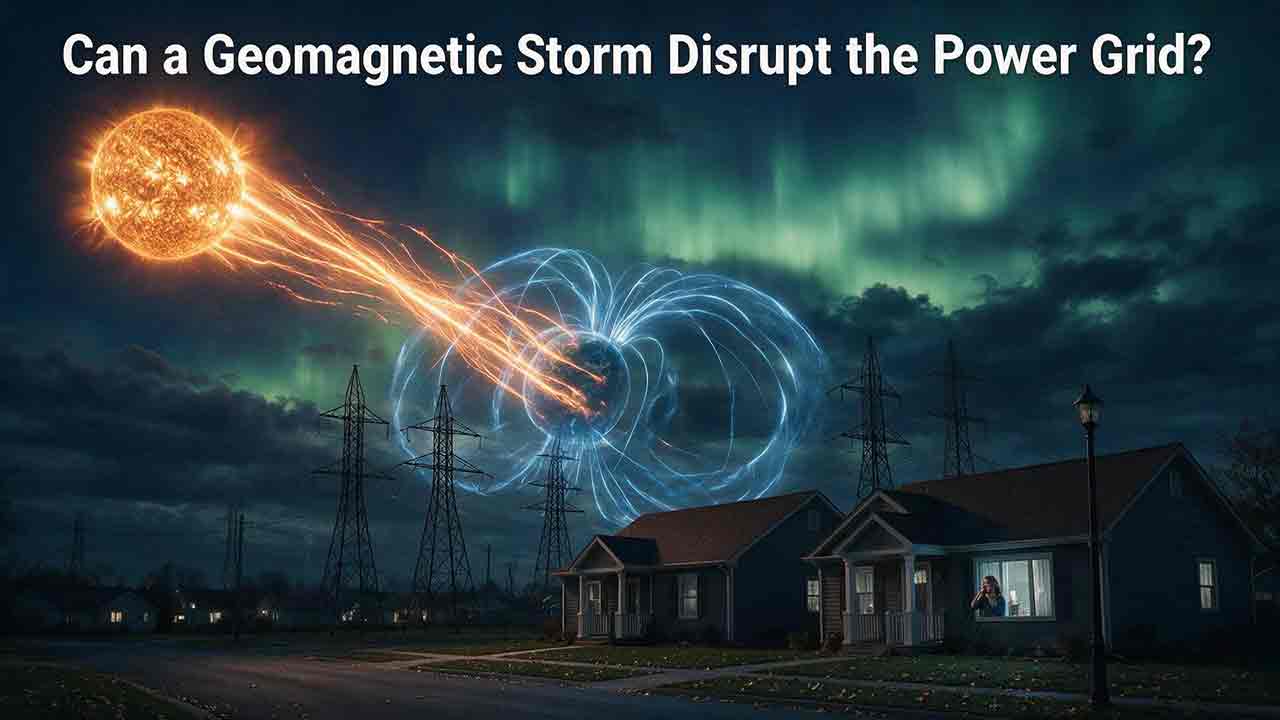
Can a Geomagnetic Storm Disrupt the Power Grid?
A geomagnetic storm can disrupt the power grid by creating geoelectric fields that drive geomagnetically induced currents through long, grounded transmission networks. This article explains how those currents can push transformers into part-cycle saturation, increase reactive-power demand, produce harmonics, trigger protective equipment, and—under severe conditions—contribute to voltage instability or a regional blackout. It also shows why a NOAA G5 rating does not automatically predict a local power failure. Using an original Four-Gate Grid Disruption Framework, a simplified voltage calculation, and a balanced comparison of the March 1989 Québec blackout and the May 2024 Gannon Storm, the guide examines how geology, line orientation, transformer design, system loading, and operator preparation shape the outcome. Readers will also find practical outage-preparation guidance for households, medical-device users, businesses, solar-and-battery owners, and critical facilities, supported by authoritative NOAA, USGS, NERC, DOE, Hydro-Québec, and Ready.gov sources.
How Does Space Weather Affect Radio Communication?
Space weather can disrupt radio communication by changing the ionosphere, the electrically charged region used by long-distance HF radio and crossed by satellite signals. This article explains how solar flares can cause almost immediate HF radio blackouts on Earth’s sunlit side, how energetic particles can weaken polar communication routes, and how geomagnetic storms can alter usable frequencies and propagation paths. It also examines ionospheric scintillation, satellite signal fading, GNSS errors, and solar radio noise. Readers will learn how to distinguish space-weather effects from antenna faults, local interference, power problems, and network outages. The article introduces the EPBS Radio Impact Check—Event, Path, Band, and Symptom—as a practical diagnostic framework, supported by a documented NOAA R3 event, a link-margin calculation, troubleshooting tables, and mitigation options. It emphasizes that forecasts describe environmental conditions rather than guaranteeing failure on any individual radio link.
Explore More Topics

How to Photograph the Northern Lights
Photographing the Northern Lights requires more than choosing one fixed camera setting. This practical guide explains how to select a camera and lens, focus accurately on stars, stabilize your equipment, and adjust shutter speed, aperture, and ISO according to the aurora’s brightness and movement. It includes starting settings for fast, moderate, and faint displays, along with a Motion–Brightness–Foreground framework that helps photographers make better decisions as conditions change. Readers will also learn how to use a smartphone Night mode, compose a stronger foreground, protect color-channel highlights, edit images responsibly, and disclose exposure blends clearly. A quick-reference card, three-frame comparison method, packing checklist, safety guidance, and detailed troubleshooting table make the article useful in the field. The guide relies on published guidance from NASA, NOAA, Nikon, Canon, and Apple while clearly distinguishing authoritative information from adjustable photography recommendations.

How Far South Can the Northern Lights Be Seen?
The northern lights usually remain within high-latitude regions, but powerful geomagnetic storms can carry visible aurora surprisingly far south. This guide explains why there is no single worldwide southern boundary and shows how geomagnetic latitude, the auroral oval, Kp, storm intensity, emission altitude, darkness, cloud cover, and local light pollution affect what an observer may see. It examines NOAA’s generalized U.S. visibility examples for G1 through G5 storms, while clarifying that locations such as Alabama, Florida, and southern Texas represent rare historical possibilities rather than guaranteed forecast limits. Readers will also find an original four-gate decision framework, an auditable geometric viewing-distance example, regional viewing guidance, a practical checklist, and troubleshooting advice for distinguishing faint aurora from clouds or artificial sky glow. The article helps observers decide when a forecast justifies going outside or traveling to a safer, darker viewing site.
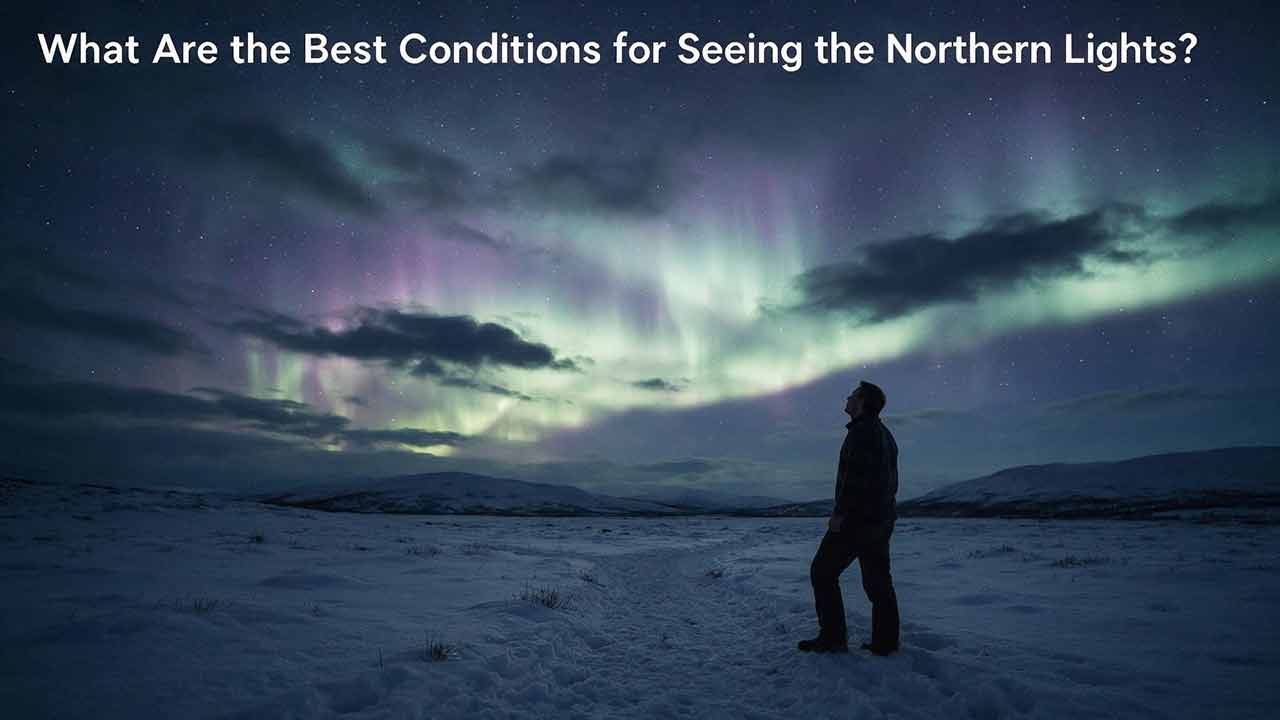
What Are the Best Conditions for Seeing the Northern Lights?
The best Northern Lights viewing conditions occur when geomagnetic activity, clear weather, darkness, and a suitable observing location align. This guide explains why the position of the auroral oval matters more than relying on a single Kp value and shows how cloud cover, twilight, light pollution, moonlight, atmospheric transparency, and horizon visibility affect what an observer can see. It introduces the Five-Gate Aurora Viewing Framework, a practical planning tool that evaluates aurora activity, clouds, darkness, location, and available viewing time without presenting the result as a guaranteed probability. Readers will also learn how to compare short- and long-range forecasts, convert UTC forecast periods, choose a safe dark-sky site, recognize faint aurora, and troubleshoot a promising forecast that produces no visible display. The article is based on guidance from NOAA, NASA, the University of Alaska Fairbanks, and the National Park Service.