Can a Geomagnetic Storm Disrupt the Power Grid?

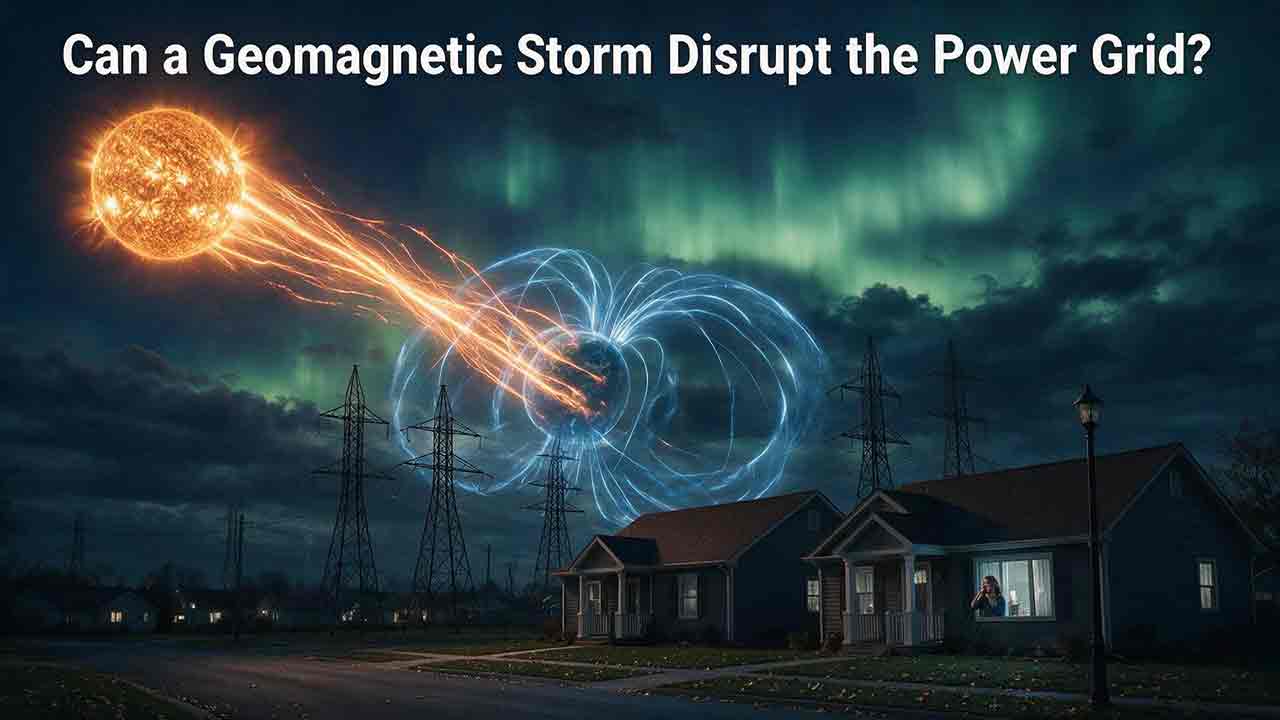
Can a Geomagnetic Storm Disrupt the Power Grid?
Yes. A geomagnetic storm can disrupt the power grid by creating geoelectric fields that drive geomagnetically induced currents through long, grounded transmission networks. Those currents can disturb transformer operation, increase reactive-power demand, generate harmonics, and trigger protective equipment. In an extreme event, the combined effects can contribute to voltage instability or a regional blackout. Most storms do not cause widespread power failure.
Key Takeaways
- Geomagnetic storms primarily affect long, grounded transmission infrastructure—not individual phones, laptops, or ordinary household cords.
- A NOAA G5 rating means severe effects are possible. It does not predict whether a particular city, utility, or country will lose power.
- Local geology, transmission-line geometry, transformer design, network configuration, system loading, and operator response all influence the outcome.
- The March 1989 storm caused a major Québec blackout, while the G5-level May 2024 Gannon Storm produced high measured currents but limited overall disruption to the North American bulk power system.
- For households, ordinary power-outage preparation is more useful than products promoted as special “solar storm protection.”
This guide follows the complete chain from solar activity to transformer stress, explains why some power systems face greater exposure than others, compares two well-documented storms, and provides practical guidance for households, businesses, and infrastructure readers.
Contents
- How Does a Geomagnetic Storm Reach the Power Grid?
- Why Are Power Transformers Vulnerable?
- Which Power Grids Face the Greatest Risk?
- Can the NOAA G Scale Predict a Blackout?
- The Four-Gate Grid Disruption Framework
- Why Do Long Transmission Paths Matter?
- What Did the 1989 and 2024 Storms Show?
- How Do Grid Operators Reduce the Risk?
- What Should Households and Businesses Do?
- Frequently Asked Questions
How Does a Geomagnetic Storm Reach the Power Grid?
A geomagnetic storm reaches the grid through electromagnetic induction. Rapid changes in magnetic fields above and around Earth can create electric fields at the surface, and those fields can drive current through sufficiently long conductive systems.
The NOAA Space Weather Prediction Center describes a geomagnetic storm as a major disturbance of Earth’s magnetosphere caused by an efficient transfer of energy from the solar wind into the space environment surrounding Earth.
Strong storms are often associated with Earth-directed coronal mass ejections, or CMEs. A CME carries plasma and an embedded magnetic field away from the Sun. If the arriving magnetic field has a favorable orientation—especially a sustained southward component—it can transfer substantial energy into Earth’s magnetic environment.
The Seven-Step Grid-Impact Chain
The physical pathway can be divided into seven steps:
A solar-wind disturbance reaches Earth.
A CME or another solar-wind structure interacts with Earth’s magnetosphere.Currents in near-Earth space intensify or move.
Magnetospheric and ionospheric current systems change in strength and location.The magnetic field measured at the ground changes.
Rapid local magnetic variation is particularly important to power-grid effects.A regional geoelectric field develops.
The changing magnetic environment induces an electric field in the conducting Earth.Voltage develops along long transmission routes.
The field acts across the effective length and direction of the network.Geomagnetically induced current flows through grounded equipment.
GIC can enter and leave the grid through transformer neutrals and other grounded paths.Transformer and voltage-control problems may follow.
Possible effects include part-cycle saturation, harmonics, increased reactive-power demand, heating, alarms, protective trips, and voltage instability.
The U.S. Geological Survey explains that naturally induced geoelectric fields can drive current through power-transmission systems and other grounded long-line infrastructure.
The Mechanism at a Glance
Solar-wind disturbance
→ changes in magnetospheric and ionospheric currents
→ rapid magnetic-field variation at the ground
→ regional geoelectric field
→ voltage along long transmission paths
→ GIC through grounded transformers
→ heating, harmonics, reactive-power demand, protection, and voltage effects
This is a simplified educational sequence. A real grid response depends on changing local fields, Earth conductivity, network topology, grounding resistance, transformer construction, system loading, and operator actions.
Why Are Power Transformers Vulnerable?
Power transformers are designed to operate with alternating current that reverses direction in a balanced cycle. GIC behaves more like a slowly varying or quasi-direct current superimposed on the alternating waveform.
That additional current can shift the magnetic operating point of a transformer core. During part of each cycle, the core may be driven into part-cycle saturation.
Part-cycle saturation can cause:
- increased reactive-power consumption;
- distorted current and voltage waveforms;
- harmonic currents;
- magnetic flux outside the intended core path;
- localized heating in windings and structural components;
- transformer temperature or GIC alarms;
- protective relay operations;
- reduced system voltage margin.
The U.S. Department of Energy’s geomagnetic-disturbance monitoring report discusses harmonics, heating, reactive-power demand, monitoring, and equipment protection among the engineering concerns associated with GIC.
Why One Transformer Alarm Is Not the Main System Risk
A single transformer alarm is usually an equipment-management issue. The larger concern is simultaneous stress across an interconnected power system.
During a severe storm, GIC peaks may occur at many substations during the same broad period. Several saturated transformers can consume additional reactive power while harmonic-related protection removes capacitor banks, filters, or other voltage-support equipment.
That combination can reduce voltage margin across a wide area. The possibility of a blackout arises from the interaction among many assets and system conditions—not simply from current flowing through one transformer.
Which Power Grids Face the Greatest Risk?
The most exposed power system is not necessarily the one located farthest north. Latitude matters, but it is only one part of the problem.
A more useful question is:
How strongly does the regional geoelectric field couple with the actual transmission network, and how much resulting stress can the operating grid absorb?
| Risk factor | Why it matters | What it does not prove |
|---|---|---|
| Rapid local magnetic-field change | Faster changes can produce stronger geoelectric fields | A planetary Kp value does not show every local peak |
| Electrically resistive geology | High surface impedance can produce larger electric fields | Locations at the same latitude need not have equal exposure |
| Long transmission paths | A field acting over a longer route can create more driving voltage | Line length alone does not determine GIC |
| Line orientation | Coupling depends on the field component aligned with the route | No compass direction is always the most vulnerable |
| Grounded transformer design | GIC needs conductive paths through grounded equipment | Transformers do not all respond in the same way |
| Network topology | Branches, parallel paths, and resistances distribute current | A one-line calculation cannot predict a substation measurement |
| Available reactive-power margin | Saturated transformers can increase reactive demand | High GIC does not automatically cause voltage collapse |
| Storm duration and repeated peaks | Repeated stress can influence heating and operator decisions | A brief peak is not equivalent to a prolonged event |
| Operator preparation | Forecasting, monitoring, and configuration changes can reduce consequences | Mitigation cannot guarantee zero risk in every possible storm |
Why Does Local Geology Matter?
Earth does not conduct electricity uniformly. Rock type, sediment structure, fluids, temperature, and geological boundaries can produce large regional differences in electrical impedance.
A USGS study of the March 1989 storm found that U.S. power-system anomalies were concentrated where the lithosphere was relatively resistive and geoelectric fields were strong, particularly in parts of the Mid-Atlantic, Northeast, and upper Midwest.
For that reconstructed event, peak one-minute geoelectric-field amplitudes ranged from:
- (21.66\ \text{V/km}) in Maine;
- (19.02\ \text{V/km}) in Virginia;
- less than (0.02\ \text{V/km}) in Idaho.
These values describe particular locations, time intervals, and modeling assumptions during the March 1989 storm. They are not universal design values or predictions for a future event.
The important observation is the range: two regions exposed to the same global storm can experience very different surface electric fields.
Does Transmission-Line Direction Matter?
Yes. The driving voltage depends on the component of the geoelectric field that acts along the transmission route.
A line closely aligned with the local electric field may experience stronger coupling than an equally long line running mostly across it. However, the field direction can change during a storm.
Real transmission networks also curve, branch, interconnect, and share current through multiple substations. Engineers therefore use time-dependent electric-field data and network models rather than assuming that every north–south or east–west line has the same risk.
Can the NOAA G Scale Predict a Blackout?
No. The NOAA G scale describes the severity of the geomagnetic environment and lists effects that may occur. It is not a local blackout-probability scale.
The official NOAA Space Weather Scales describe the following potential power-system effects:
| NOAA level | Kp reference | Possible power-system effects |
|---|---|---|
| G1 — Minor | 5 | Weak power-grid fluctuations can occur |
| G2 — Moderate | 6 | High-latitude voltage alarms may occur; a long-duration storm may contribute to transformer stress |
| G3 — Strong | 7 | Voltage correction may be required; some protection devices may produce false alarms |
| G4 — Severe | 8, including 9− | Widespread voltage-control problems and incorrect protective trips are possible |
| G5 — Extreme | 9 | Some systems may experience severe voltage problems, protective-system problems, blackout, collapse, or transformer damage |
The word possible is essential. A G5 rating does not mean every region will experience all listed effects.
What the G Scale Can Tell You
The G scale can help answer:
- How disturbed is the global geomagnetic environment?
- What broad categories of effects may become possible?
- Does the event deserve increased attention from operators and infrastructure users?
What the G Scale Cannot Tell You
The G scale does not directly reveal:
- the electric field at a specific substation;
- the current in an individual transformer neutral;
- local ground conductivity;
- transmission-line alignment and resistance;
- available reactive-power reserves;
- equipment already unavailable for maintenance;
- operator actions already taken;
- the probability that a particular city will lose power.
Kp is a planetary index assembled from observations at multiple magnetic stations over three-hour intervals. It is useful for describing broad storm severity but cannot capture every short, localized variation relevant to GIC.
The Four-Gate Grid Disruption Framework
The framework below is an editorial synthesis developed for this article. It is not an official NOAA, USGS, FERC, DOE, or NERC rating system.
Its purpose is to organize the physical and operational factors described by the cited sources so readers do not mistake a global storm label for a local outage forecast.
Gate 1: Is the Magnetic Disturbance Strong and Rapid?
A high G rating raises concern, but the rate and timing of local magnetic-field changes also matter.
A storm with repeated sharp variations may produce consequential local electric fields even when a broad global summary does not describe each regional peak.
Diagnostic question: Is the region experiencing rapid magnetic variation, rather than only a high headline storm level?
Gate 2: Does the Ground Produce a Strong Geoelectric Field?
The same magnetic disturbance can produce different surface electric fields in different geological settings.
Resistive or geologically complex regions may experience larger fields than more conductive regions under similar magnetic conditions.
Diagnostic question: Does the regional Earth-conductivity structure amplify the electric field acting on infrastructure?
Gate 3: Does the Grid Provide an Effective Current Path?
A geoelectric field must couple with a conductive network before substantial GIC can flow.
Important factors include:
- effective line length;
- line orientation;
- transformer-neutral grounding;
- line and grounding resistance;
- transformer winding configuration;
- parallel transmission paths.
Diagnostic question: Does the network geometry allow the regional field to drive meaningful current through grounded equipment?
Gate 4: Can the Operating Grid Absorb the Disturbance?
A grid with adequate reactive reserves, available voltage support, reliable monitoring, and trained operators has more options.
A system may have less margin when it is already dealing with:
- high electricity demand;
- severe terrestrial weather;
- generation constraints;
- planned transmission maintenance;
- unavailable capacitor banks or compensators;
- other equipment outages.
Diagnostic question: Is there enough operating margin to manage additional reactive demand, heating, alarms, or equipment trips?
How to Interpret the Four Gates
| Elevated gates | Practical interpretation |
|---|---|
| One | A strong storm signal or isolated vulnerability exists, but a severe grid outcome is not established |
| Two | Regional exposure deserves closer observation |
| Three | Meaningful transformer or voltage effects become more plausible |
| Four | Both the physical pathway and operational vulnerability are present; consequences depend on severity and response |
This framework is not a numerical probability model. It is a structured way to identify which information is still missing before making claims about grid disruption.
An Original Observation: Grid Risk Is Sequential
Geomagnetic grid risk is often discussed as though every risk factor simply adds points to a score. In practice, the process is partly sequential.
A severe magnetospheric disturbance cannot drive large GIC through a network if the regional geoelectric field is weak. A strong geoelectric field will not produce the same current in every grid if effective conductive paths differ. High GIC does not necessarily become a blackout if the system retains sufficient voltage support and operators intervene successfully.
This explains why no single number—whether Kp, latitude, line length, or measured current—can fully describe the outcome.
Why Do Long Transmission Paths Matter?
A useful first-order illustration of the driving voltage is:
[V \approx E_{\parallel} \times L_{\text{effective}}]
where:
- (V) is the approximate voltage developed along the route;
- (E_{\parallel}) is the component of the geoelectric field aligned with the route;
- (L_{\text{effective}}) is the effective aligned length of the transmission path.
Suppose a simplified uniform field of (1\ \text{V/km}) acts along an effective (500\ \text{km}) route:
[V \approx 1\ \text{V/km} \times 500\ \text{km} = 500\ \text{V}]
This result does not mean that 500 volts appears at a household outlet. It represents a simplified driving voltage distributed along a very large grounded transmission path.
Why the Example Is Only a Teaching Tool
The example assumes:
- a uniform electric field;
- constant alignment with the route;
- one effective transmission path;
- no branching or parallel paths;
- no changes in field direction;
- no detailed line, transformer, or grounding resistance.
A more accurate route calculation integrates the changing electric field along the transmission path:
[V = \int_{\text{route}} \mathbf{E} \cdot d\mathbf{l}]
The resulting GIC must then be calculated using the electrical properties and topology of the network.
The example explains why scale and alignment matter. It does not estimate current in a real transformer or substation.
What Happened During the March 1989 Storm?
The March 1989 storm demonstrated that geomagnetic activity can contribute to a real regional grid collapse.
According to USGS research on the March 1989 magnetic superstorm, violent magnetic-field fluctuations triggered grid protection systems. The Québec network collapsed in less than a minute, and the province remained without power for more than nine hours.
Power-system anomalies were also documented in the United States.
What the 1989 Event Established
The event showed that:
- GIC is not merely a theoretical engineering concern;
- protection and voltage-support problems can develop rapidly;
- a disturbance can affect a broad interconnected network;
- local geology can influence where grid interference occurs;
- an extreme geomagnetic event can contribute to a regional blackout.
What It Did Not Establish
The event did not prove that:
- every future extreme storm will reproduce the Québec outage;
- every northern power system has the same vulnerability;
- a planetary index can identify which transformer will be affected;
- modern monitoring and operating procedures eliminate all risk.
Historical events demonstrate physical possibility. They are not exact templates for future outcomes.
What Did the May 2024 Gannon Storm Show?
The May 10–12, 2024 Gannon Storm produced conditions ranging from G3 to G5 and was the largest geomagnetic disturbance in more than two decades.
The North American bulk power system remained stable, but the event was not operationally invisible.
According to NERC’s January 2026 May 2024 Geomagnetic Disturbance Event Review, operators observed:
- elevated GIC;
- harmonic distortion;
- transformer alarms;
- isolated equipment trips;
- generator effects;
- operator interventions.
System voltages nevertheless remained within operating limits.
What Did the Monitoring Network Measure?
NERC reported collecting registered-entity measurements from more than 397 GIC monitors and 15 magnetometers for the event.
The dataset covered the U.S. portion of the bulk power system. NERC explicitly noted that its GMD Data System did not contain reports from Canadian entities for the Gannon Storm.
The highest reported U.S. measurement was:
- 175.7 amperes;
- measured as total direct current in a transformer neutral;
- recorded at a monitor in Wisconsin;
- just after 02:03 UTC on May 11, 2024.
GIC was measured over approximately 36 hours. That does not mean the 175.7-ampere peak continued for 36 hours; the current rose and fell throughout the event.
These figures and their reporting boundaries are documented in the NERC event review.
What Happened to Generators and Transformers?
NERC reported that one nuclear generating unit in the northeastern United States reduced output under its operating procedure after high GIC was measured in its generator step-up transformer.
Other reported effects included:
- transformer top-oil temperature alarms;
- generator step-up transformer relay operations;
- harmonic-filter trips;
- an isolated surge-arrester failure;
- possible harmonic-related effects on voltage-support and transmission equipment.
NERC found that no transformer outages attributed to GIC were reported into the Transmission Availability Data System, or TADS, for the event.
That statement has an important boundary. It does not mean no transformer experienced elevated current, heating, alarms, or operator attention. It means no qualifying transformer outage attributed to GIC was reported into that specific database.
NERC also noted that some voltage-support components are not independently tracked in TADS unless their loss produces a reportable transmission-system outage.
How Much Warning Did Operators Receive?
For this event, NOAA used the NERC Reliability Coordinator hotline approximately six hours before the onset of GMD activity associated with the leading CME.
NERC reported that the early notification allowed operators to implement extensive mitigation measures.
The six-hour period should not be treated as a standard warning time. More precise information often becomes available only after the disturbance reaches a monitoring spacecraft near the Sun–Earth L1 point. The NERC report notes that this stage may provide as little as approximately 30 minutes of advance warning for a fast CME.
Both figures are specific to the forecasting and notification discussion in the NERC Gannon Storm report.
What Can Be Learned From 1989 and 2024?
The useful conclusion is not that the 1989 grid was weak and the modern grid is safe. The evidence supports a more careful interpretation.
| Question | March 1989 | May 2024 |
|---|---|---|
| Broad outcome | Major Québec grid collapse | North American bulk power system remained stable |
| Observed effects | Protection and voltage problems, widespread operational anomalies | High GIC, harmonics, alarms, deratings, and isolated trips |
| Monitoring context | Earlier monitoring and operating environment | More extensive monitoring, formal procedures, and NOAA–NERC notification |
| Main lesson | Extreme geomagnetic activity can contribute to regional blackout | Extreme global conditions do not guarantee widespread blackout |
| Incorrect conclusion | Every comparable storm will reproduce the same collapse | The modern grid is immune to a stronger or differently structured event |
The comparison supports three conclusions:
- The physical hazard is real.
- Preparedness and operating action can materially reduce consequences.
- A global storm label does not determine the local result.
These two events are illustrative comparisons, not a statistical sample from which to calculate the probability of a future blackout.
How Do Grid Operators Reduce the Risk?
Grid operators reduce geomagnetic risk through long-term planning, equipment assessment, monitoring, forecasting, and real-time operating procedures.
The actions described below are broad categories. They are not instructions for operating an electrical transmission system.
Which NERC Entities Are Covered by Planning Requirements?
NERC Reliability Standard TPL-007-4 applies to specified:
- Planning Coordinators;
- Transmission Planners;
- Transmission Owners;
- Generator Owners.
Its facility criteria include power transformers with a high-side, wye-grounded winding and a terminal voltage greater than 200 kV.
The standard requires responsible entities identified through its process to maintain relevant models and complete a benchmark GMD vulnerability assessment at least once every 60 calendar months.
Depending on applicability and assessment results, work may include:
- geoelectric-field calculations;
- transmission and GIC system models;
- on-peak and off-peak voltage studies;
- transformer thermal-impact assessments;
- corrective action plans;
- measurement-data processes;
- hardware or non-hardware mitigation.
These requirements do not apply identically to every utility, distribution company, generator, or power-system organization.
Which Entities Must Maintain Operating Plans or Procedures?
NERC Reliability Standard EOP-010-1 applies to Reliability Coordinators and covered Transmission Operators.
Under the standard:
- covered Reliability Coordinators must develop, maintain, and implement coordinated GMD operating plans;
- Reliability Coordinators must distribute forecast and current space-weather information to identified recipients;
- covered Transmission Operators must maintain GMD operating procedures or processes;
- operator actions must be connected to predetermined conditions.
This is a general description of the standard’s stated applicability, not legal advice about any organization or jurisdiction.
What Actions May Operators Consider?
Depending on approved procedures and current system conditions, operators may consider:
- increasing GIC and harmonic monitoring;
- observing transformer temperatures and alarms;
- preserving reactive-power reserves;
- delaying planned transmission maintenance;
- returning available lines or voltage-support equipment to service;
- scheduling additional generation;
- placing harmonic filters into service;
- using installed GIC-blocking equipment;
- selecting a network configuration previously assessed as more resilient;
- reducing generation when transformer procedures require it.
Only trained personnel with system models, equipment limits, and approved operating authority should make these decisions.
Why Monitoring Matters
A forecast describes the space environment. Grid monitors show what the power system is actually experiencing.
Useful measurements can include:
- transformer-neutral GIC;
- local magnetic-field variation;
- harmonic currents;
- transformer temperatures;
- reactive-power demand;
- bus voltage;
- protection-system activity;
- equipment status.
Monitoring helps distinguish between a severe global forecast and a severe local equipment response.
Can a Geomagnetic Storm Directly Damage Household Electronics?
Direct geomagnetic coupling into a phone, laptop, television, or short household cord is not the primary grid hazard.
A regional geoelectric field becomes important when it acts over a long conductive path. Consumer devices do not provide hundreds of kilometers of connected transmission route over which substantial driving voltage can accumulate.
Households can still be affected indirectly through:
- loss of utility power;
- voltage fluctuations;
- switching or restoration transients;
- communication outages;
- interruptions to fuel, payment, water, or transportation services;
- GPS or radio disruption caused by the same space-weather event.
A surge protector may help with some ordinary electrical transients. It cannot protect a regional transmission network or provide power during an outage.
A UPS, home battery, or properly installed generator addresses a different problem: maintaining selected loads when grid electricity is unavailable.
What Should Households and Businesses Do?
Most people do not need specialized geomagnetic-storm equipment. The practical goal is resilience during an ordinary power outage.
| User or situation | Practical priority | Important limitation |
|---|---|---|
| Typical household | Flashlights, charged power banks, basic supplies, and utility contact information | Supplies do not prevent or predict an outage |
| Remote worker | UPS for controlled shutdown, automatic saving, and an alternate connection plan | A small UPS may provide only brief runtime |
| Powered medical-device user | A documented backup-power and relocation plan developed with healthcare and utility contacts | Do not wait for a severe storm alert to create the plan |
| Refrigerated medicine user | Obtain storage and outage instructions from a pharmacist or healthcare professional | Medication requirements differ |
| Small business | Identify critical loads, shutdown procedures, payment alternatives, and communication channels | Backup capacity must match the intended loads |
| Data center or critical facility | Verify UPS, generation, cooling, fuel, monitoring, and escalation readiness | Backup systems require maintenance and testing |
| Solar-and-battery owner | Confirm which circuits are backed up and whether islanded operation is supported | Many grid-tied solar systems shut down during an outage |
| Infrastructure professional | Follow official forecasts and approved organizational procedures | Public articles cannot replace system-specific analysis |
Ready.gov’s power-outage guidance recommends identifying electricity-dependent needs, arranging alternative power, charging communication devices, and developing specific plans for powered medical equipment and refrigerated medicine.
If a loss of power creates an immediate threat to health or life, contact local emergency services. Do not rely only on a utility dashboard, website, or space-weather forecast.
A Practical Alert-to-Action Guide
This table provides general outage-preparedness guidance. It does not predict local grid conditions.
| Information available | Reasonable public response |
|---|---|
| G1–G3 conditions and no local utility warning | Continue normal activities and maintain routine outage readiness |
| G4 or G5 forecast, with no local grid issue | Charge essential devices, check normal supplies, and monitor official information |
| Utility issues an operational or conservation alert | Follow the utility’s instructions and prepare for possible interruption |
| Repeated flickering or local outages occur | Save work, use a UPS for controlled shutdown, and check the official outage map |
| Medical power continuity may be at risk | Activate the prearranged medical and backup-power plan early |
| Downed lines, smoke, sparks, or damaged equipment appear | Stay away and contact the utility or emergency services |
| Severe terrestrial weather occurs at the same time | Prepare for combined hazards; local weather may be the immediate outage cause |
The headline G level should not be the only trigger for personal action. Medical needs, actual grid conditions, and local utility information are usually more actionable.
What Should You Not Do During a Geomagnetic Storm?
Do Not Treat a G5 Alert as a Guaranteed Blackout
The May 2024 storm reached G5 while the North American bulk power system remained stable.
G5 means severe effects are possible—not certain in every location.
Do Not Treat an Aurora Map as a Grid-Risk Map
Auroral visibility and grid exposure both relate to geomagnetic activity, but they are not interchangeable.
Grid effects also depend on regional geology, electric-field direction, transmission-network geometry, transformer grounding, and operating conditions.
Do Not Diagnose Every Outage as a Solar-Storm Effect
Most outages result from terrestrial causes such as severe weather, vegetation, equipment faults, animals, fires, vehicle collisions, or switching operations.
A geomagnetic storm occurring at the same time does not establish the cause.
Do Not Buy Products Based on Unverifiable Protection Claims
A consumer device cannot shield a regional transmission grid from GIC.
Evaluate surge protectors, batteries, generators, inverters, and transfer equipment using recognized specifications, capacity, installation requirements, and safety standards—not dramatic claims about blocking solar storms.
Do Not Run a Generator Indoors
Portable generators and other fuel-burning equipment can produce lethal carbon monoxide.
Ready.gov advises operating generators outdoors and at least 20 feet from windows, doors, and attached garages. Follow the manufacturer’s instructions and applicable fire and electrical requirements.
Do Not Backfeed Building Wiring
Connecting a generator to building wiring through an improvised cord can energize utility lines, injure workers, damage equipment, and create fire or shock hazards.
A generator connected to permanent wiring requires appropriate transfer equipment and professional installation consistent with applicable codes.
What Should You Do if the Lights Flicker?
Treat flickering as an electrical or utility problem first—not as proof of a geomagnetic effect.
- Save open work.
- Allow a UPS to perform a controlled shutdown if interruptions continue.
- Check whether nearby buildings are also affected.
- Review the official utility outage map or alert service.
- Disconnect nonessential sensitive equipment if repeated interruptions occur and it is safe to do so.
- Keep refrigerator and freezer doors closed during a sustained outage.
- Stay away from fallen wires and damaged utility equipment.
- Report smoke, sparks, fire, or downed lines immediately.
Do not open electrical panels, modify wiring, or attempt to repair utility equipment.
Which Common Claims Are Misleading?
| Claim | More accurate interpretation |
|---|---|
| “A solar flare will hit the grid” | The main GIC threat is usually associated with a geomagnetic storm driven by an arriving solar-wind disturbance such as a CME |
| “Kp 9 means the whole country will go dark” | Kp 9 indicates extreme planetary activity, not a nationwide outage prediction |
| “Only far-northern grids are at risk” | Latitude matters, but geology and network design can make lower-latitude regions important |
| “All large transformers will burn out” | Transformer responses vary; heating, alarms, harmonics, derating, and protective trips are more defensible possibilities |
| “Modern grids solved the problem after 1989” | Monitoring and procedures have improved, but severe GMD remains a recognized reliability hazard |
| “No major blackout in 2024 means G5 is harmless” | The event produced high GIC and isolated equipment effects despite stable bulk-system operation |
Who Is This Guide For—and What Is It Not?
This guide is intended for:
- readers seeking a technically accurate explanation without specialist engineering training;
- households deciding how to interpret a severe space-weather alert;
- educators explaining the connection between space weather and infrastructure;
- business owners reviewing power-continuity plans;
- journalists and content creators who want to avoid exaggerated blackout claims;
- readers comparing the March 1989 and May 2024 events.
It is not:
- a utility control-room manual;
- a transformer thermal model;
- a protection-setting guide;
- electrical installation advice;
- a legal interpretation of reliability standards;
- a real-time forecast of local grid conditions.
The Practical Bottom Line
A geomagnetic storm can disrupt the power grid. In a sufficiently severe event, GIC can contribute to transformer saturation, heating, harmonics, reactive-power loss, protective operations, voltage instability, and regional blackout.
The risk is significant enough that covered entities within the NERC reliability framework must maintain specified assessments, plans, or procedures under the standards that apply to them. That does not make a blackout inevitable.
For most households, the best response is normal outage preparation. People with power-dependent medical needs require a specific continuity plan. Businesses should identify critical loads and communication dependencies. Infrastructure professionals should rely on approved system models and operating procedures rather than public storm headlines.
Frequently Asked Questions
Can a solar flare directly shut down the power grid?
A solar flare is a burst of electromagnetic radiation that can rapidly affect the ionosphere and radio communication. The main GIC threat to the power grid is more commonly associated with a geomagnetic storm caused by an arriving CME or another solar-wind disturbance.
A flare may accompany an eruption that launches a CME, but the flare and CME are distinct events with different travel times and technological effects.
Could a geomagnetic storm cause a nationwide blackout?
A severe storm could affect equipment over a wide interconnected region, but a nationwide blackout is not an automatic outcome.
The result would depend on regional electric fields, grid topology, transformer exposure, system loading, voltage support, protection behavior, and operator response. Forecasting global storm intensity is easier than predicting a specific nationwide electrical failure.
Are local distribution lines as vulnerable as high-voltage transmission lines?
The primary systemic concern involves long, grounded high-voltage transmission networks because their scale and transformer configuration can provide effective GIC paths.
Distribution systems can still experience indirect effects through loss of upstream supply, voltage disturbances, harmonics, or equipment trips. Their exposure is not identical to that of the bulk transmission system.
How much warning can grid operators receive?
An Earth-directed CME may be observed a day or more before arrival, but its exact magnetic orientation and geoeffectiveness remain uncertain.
Measurements closer to Earth provide better information but less time. The May 2024 event allowed an unusually useful six-hour hotline notification, while more precise near-Earth observations may sometimes provide only tens of minutes of warning.
Will rooftop solar panels keep working during a grid outage?
Many standard grid-tied solar systems shut down during an outage to avoid energizing utility lines.
A system can provide backup only if it has compatible islanding controls, a suitable inverter, approved switching equipment, and usually a battery or another source that stabilizes the local electrical system. Owners should confirm the actual system configuration rather than assuming solar panels guarantee power.
Should I unplug electronics during a G5 storm?
A G5 alert alone does not require every household to unplug all electronics.
Monitor the local utility. If repeated interruptions, voltage problems, or an outage occur, disconnecting nonessential sensitive equipment may reduce exposure to ordinary switching and restoration transients. Do not handle electrical equipment in wet or otherwise unsafe conditions.
Sources
Space-Weather Definitions and Scales
- NOAA Space Weather Prediction Center — Geomagnetic Storms
- NOAA Space Weather Prediction Center — NOAA Space Weather Scales
Geoelectric Hazard and Historical Research
- U.S. Geological Survey — Geomagnetism Program Overview
- U.S. Geological Survey — Mapping a Magnetic Superstorm: March 1989 Geoelectric Hazards and Impacts on United States Power Systems
- U.S. Geological Survey — Magnetic Storms and Geoelectric Hazards
- U.S. Geological Survey — Mapping the March 1989 Magnetic Superstorm
Grid Reliability and Engineering
- North American Electric Reliability Corporation — May 2024 Geomagnetic Disturbance Event Review
- North American Electric Reliability Corporation — Reliability Standard TPL-007-4
- North American Electric Reliability Corporation — Reliability Standard EOP-010-1
- U.S. Department of Energy — Geomagnetic Disturbance Monitoring Approach and Implementation Strategies
Public Outage Safety
Editorial Method
This article draws on published government research, official space-weather information, NERC reliability standards applicable to covered entities, utility documentation, and documented grid-event data.
The explanatory framework, comparison tables, and calculation example were developed to organize the physical and operational factors described in those sources. They are educational tools rather than official forecasting systems, engineering standards, regulatory tests, or probability models.
The May 2024 figures are presented with their reporting boundaries:
- the monitor count describes measurements collected from registered reporting entities;
- the NERC dataset covers the U.S. portion of the bulk power system and did not include Canadian-entity reports in that collection;
- 175.7 amperes refers to total direct current measured in a transformer neutral;
- 36 hours describes the measurement window, not the duration of the peak;
- the transformer-outage statement is limited to outages attributed to GIC and reported into TADS.
Author Note
This article is an evidence-based educational explanation developed from the official sources listed above. It does not claim independent transformer testing, access to private utility models, real-time control-room information, or a formal engineering review.
Editorial notice: This article provides general scientific, infrastructure, and outage-preparedness information. It does not provide real-time utility operating instructions, electrical installation guidance, legal advice, medical advice, or a forecast of local power-system conditions.
More from Technology & Infrastructure Impacts
Can Solar Storms Damage Phones, Cars, or Home Electronics?
Solar storms are unlikely to directly destroy phones, disable passenger cars, or fry unplugged home electronics at ground level. The more realistic risks are indirect: degraded GPS accuracy, interrupted satellite or cellular services, power-grid disturbances, unavailable EV chargers, fuel-pump outages, and ordinary electrical problems during power restoration. This article explains why long, grounded infrastructure is more vulnerable to geomagnetically induced currents than compact consumer devices. It also separates solar flares, radiation storms, coronal mass ejections, and geomagnetic storms so readers can understand which technology effects belong to each event. Using the original Scale–Path–Dependency–Recovery framework, risk matrices, a May 2024 storm case study, troubleshooting guidance, and user-specific preparation advice, the guide helps households evaluate realistic exposure without fear-based claims. It also covers surge-protection limits, medical-equipment planning, offline navigation, EV charging, and safe outage preparation based on authoritative NOAA, NASA, USGS, NIST, Department of Energy, and Ready.gov guidance.
How Does Space Weather Affect Radio Communication?
Space weather can disrupt radio communication by changing the ionosphere, the electrically charged region used by long-distance HF radio and crossed by satellite signals. This article explains how solar flares can cause almost immediate HF radio blackouts on Earth’s sunlit side, how energetic particles can weaken polar communication routes, and how geomagnetic storms can alter usable frequencies and propagation paths. It also examines ionospheric scintillation, satellite signal fading, GNSS errors, and solar radio noise. Readers will learn how to distinguish space-weather effects from antenna faults, local interference, power problems, and network outages. The article introduces the EPBS Radio Impact Check—Event, Path, Band, and Symptom—as a practical diagnostic framework, supported by a documented NOAA R3 event, a link-margin calculation, troubleshooting tables, and mitigation options. It emphasizes that forecasts describe environmental conditions rather than guaranteeing failure on any individual radio link.
Can Solar Storms Damage Satellites?
Solar storms can disrupt satellites and, under unfavorable conditions, cause permanent hardware damage or mission loss. This article explains how energetic particles can upset electronics, how surface and internal charging may trigger electrical discharges, and why geomagnetic storms increase atmospheric drag on satellites in low Earth orbit. It also compares risks across low, medium, geostationary, polar, and deep-space orbits. Using the February 2022 Starlink losses as a documented example, the guide shows why orbit, spacecraft design, mission phase, storm duration, and recovery capability matter more than a storm rating alone. Readers will also find an illustrative drag calculation, an orbit-based risk table, the original ORBIT comparison framework, a pre-storm readiness checklist, and a practical anomaly-investigation process. The article draws on NASA, NOAA, ESA, and peer-reviewed sources while clearly distinguishing general education from mission-specific engineering advice.
Explore More Topics

How to Photograph the Northern Lights
Photographing the Northern Lights requires more than choosing one fixed camera setting. This practical guide explains how to select a camera and lens, focus accurately on stars, stabilize your equipment, and adjust shutter speed, aperture, and ISO according to the aurora’s brightness and movement. It includes starting settings for fast, moderate, and faint displays, along with a Motion–Brightness–Foreground framework that helps photographers make better decisions as conditions change. Readers will also learn how to use a smartphone Night mode, compose a stronger foreground, protect color-channel highlights, edit images responsibly, and disclose exposure blends clearly. A quick-reference card, three-frame comparison method, packing checklist, safety guidance, and detailed troubleshooting table make the article useful in the field. The guide relies on published guidance from NASA, NOAA, Nikon, Canon, and Apple while clearly distinguishing authoritative information from adjustable photography recommendations.
How Far South Can the Northern Lights Be Seen?
The northern lights usually remain within high-latitude regions, but powerful geomagnetic storms can carry visible aurora surprisingly far south. This guide explains why there is no single worldwide southern boundary and shows how geomagnetic latitude, the auroral oval, Kp, storm intensity, emission altitude, darkness, cloud cover, and local light pollution affect what an observer may see. It examines NOAA’s generalized U.S. visibility examples for G1 through G5 storms, while clarifying that locations such as Alabama, Florida, and southern Texas represent rare historical possibilities rather than guaranteed forecast limits. Readers will also find an original four-gate decision framework, an auditable geometric viewing-distance example, regional viewing guidance, a practical checklist, and troubleshooting advice for distinguishing faint aurora from clouds or artificial sky glow. The article helps observers decide when a forecast justifies going outside or traveling to a safer, darker viewing site.
What Are the Best Conditions for Seeing the Northern Lights?
The best Northern Lights viewing conditions occur when geomagnetic activity, clear weather, darkness, and a suitable observing location align. This guide explains why the position of the auroral oval matters more than relying on a single Kp value and shows how cloud cover, twilight, light pollution, moonlight, atmospheric transparency, and horizon visibility affect what an observer can see. It introduces the Five-Gate Aurora Viewing Framework, a practical planning tool that evaluates aurora activity, clouds, darkness, location, and available viewing time without presenting the result as a guaranteed probability. Readers will also learn how to compare short- and long-range forecasts, convert UTC forecast periods, choose a safe dark-sky site, recognize faint aurora, and troubleshoot a promising forecast that produces no visible display. The article is based on guidance from NOAA, NASA, the University of Alaska Fairbanks, and the National Park Service.